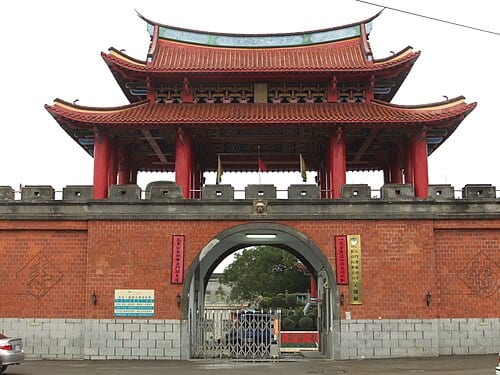
Kinmen Walled City is a Ming-dynasty coastal defense garrison in the southwest of Kinmen Island, established in 1387 (the 20th year of the Hongwu reign) and largely completed the following year, making it one of the island's earliest surviving military fortifications. The surviving north wall section, built with oyster-shell lime mortar, has been registered as part of the "Ming-Qing Kinmen City Ruins" heritage site.
Kinmen Walled City's garrison was begun in the 20th year of the Hongwu reign (1387) and largely completed by the second lunar month of the following year (1388). The original wall ran about 630 zhang (roughly 2,016 meters) in circumference and stood about 1 zhang 7 chi (roughly 5.4 meters) tall. The "Ming-Qing Kinmen City Ruins" were officially registered as a Kinmen County cultural heritage site in 2022.
Highlights of Kinmen Walled City (Ming-Dynasty Ramparts)
The Kinmen Walled City garrison was established under the Fujian Metropolitan Command of the Ming coastal defense system, originally functioning to repel Japanese pirates and maintain maritime order. The city site was chosen at a higher elevation in the southwest corner of Kinmen Island to command views over the surrounding waters. The surviving wall section uses oyster-shell lime as its primary binding material — a traditional building material of the Min-Nan coastal region, made by burning and grinding oyster shells.
The northern wall section is the most intact surviving structure and has been designated a Kinmen County historical monument. Some foundation outlines of the city site can still be traced nearby, and interpretation panels explain the garrison's historical background and the extent of what survives today. Compared to Kinmen's other attractions — which are mostly Republic-of-China-era military relics — this site represents a much deeper historical timeline, making it an important starting point for understanding the arc of Kinmen's development.
Tips for Getting the Most Out of Your Visit
Practical Information
Getting There & Hours
- The ruins are in the southwest of Jincheng Township, not far from Shuitou Village. Driving or renting a vehicle is the easiest way to reach them; the walking range on site is limited, so having your own transport is recommended.
- The site is an outdoor open space with no ticketing. Visit during daylight hours to ensure sufficient light for examining the wall details.
Nearby Connections
- Shuitou Village and Shuitou Pier are nearby. They can be combined into the same day's itinerary, spanning a historical range from the Ming Dynasty through the Republican-era overseas remittance period.
- Zhaishan Tunnel is also to the southwest of Jincheng Township and can be added as an extension to a half-day route.
Sources: Kinmen County Cultural Affairs Bureau; Wikipedia entry on Kinmen Walled City.
Frequently Asked Questions
When was Kinmen Walled City built?
The garrison was established in 1387, the 20th year of the Hongwu reign, and largely completed by early 1388, making it the earliest surviving military fortification on Kinmen Island.
What material was the north wall built with?
The surviving north wall section is bonded primarily with oyster-shell lime, a traditional Min-Nan coastal building material made by burning and grinding oyster shells.
Is the site officially protected as a heritage site?
Yes, the "Ming-Qing Kinmen City Ruins" were officially registered as a Kinmen County cultural heritage site in 2022.
Sources
- 金門縣政府-「明清金門城遺跡」經公告登錄為金門縣史蹟 — 金門城遺跡文化資產登錄公告
- 金門守禦千戶所城 - 維基百科 — 金門城建城年代與城牆規格