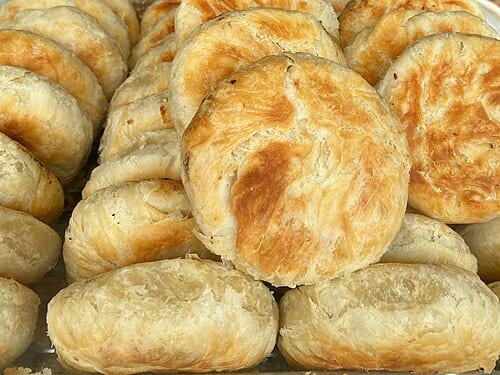
Kinmen Fujianese Shaobing Flatbread is a charcoal-oven-baked specialty unique to Shamei Old Street, sold in savory and sweet versions and coated in white sesame seeds. The shop on Bo'ai Street in Jinsha Township has operated for more than 30 years; the savory version is filled with Kinmen lees-marinated pork thigh and pearl green onion, while the sweet version uses a fine-sugar filling suitable for vegetarians. Baked fresh daily, batches typically sell out as soon as they leave the oven, making it a staple of both local breakfasts and souvenir shopping.
The Fujianese shaobing specialty shop on Bo'ai Street in Jinsha Township, Shamei, has operated for more than 30 years, open daily from 7 a.m. to 4 p.m. (closed Thursdays). The savory version is filled with Kinmen lees-marinated pork thigh and pearl green onion; the sweet version uses a vegetarian-friendly fine-sugar filling. Batches routinely sell out shortly after coming out of the oven.
What is Kinmen Fujianese Shaobing Flatbread
Kinmen Fujianese shaobing is a traditional pastry rooted in Hokkien ritual traditions, shaped as a crescent or long rectangle, covered in white sesame seeds, and baked by pressing against the wall of a charcoal oven. The dough uses a leavened starter, producing a crust that is crisp on the outside and soft inside. The savory filling uses Kinmen lees-marinated pork, pearl green onion (thin scallion), and white pepper; the sweet filling uses malt sugar, sesame, and brown sugar. Both styles have loyal followings.
Why does it represent Kinmen? Kinmen Fujianese shaobing differs clearly from its main-island counterpart — the main island's version is typically baked in a barrel oven and shaped as a rectangle; Kinmen's is crescent-shaped and charcoal-oven-baked, and the savory filling uses "Kinmen lees-fed pork," an ingredient unique to the island. The Fujianese shaobing specialty shops in Shamei Old Street have been operating for over 30 years and are officially listed on kinmen.travel. Serving both savory and sweet is the combination tourists are expected to try.
How to eat it the local way
Local knowledge
Verified facts (sponsored content filtered)
- Officially listed by the Kinmen County Tourism Bureau (kinmen.travel) as the signature morning snack of Shamei Old Street, Jinsha.
- The savory shaobing uses Kinmen lees-marinated pork and pearl green onion — an ingredient combination unique to Kinmen.
- Fujianese shaobing traces its origins to Hokkien ritual traditions; shaobing specialty shops in Shamei Old Street have operated for over 30 years.
Visitor tips
- Most shops operate from early morning to noon; they often sell out before noon on weekends — arrive by 10 a.m. to be safe.
- Shamei Old Street is in Jinsha Township, about 20 minutes by car from Jincheng; plan it as part of a Jinsha itinerary.
- Charcoal-oven baking requires waiting for each batch; during busy periods, allow 15–30 minutes of wait time.
Data compiled from the Kinmen County Tourism Bureau, Kinmen Winery, and a large volume of public reviews, with sponsored content filtered out.
Frequently Asked Questions
What two flavors does Kinmen Fujianese shaobing come in?
It comes in a savory version filled with Kinmen lees-marinated pork thigh and pearl green onion, and a sweet version with a vegetarian-friendly fine-sugar filling.
How long has the Shamei shaobing shop been operating?
The specialty shop on Shamei's Bo'ai Street has been operating for more than 30 years, baking fresh batches daily.
When is the best time to visit?
The shop is open from 7 a.m. to 4 p.m. daily except Thursdays, and batches often sell out quickly after baking, so arriving early is recommended.
Sources
- 閩式燒餅 | 金門觀光旅遊網 — 金門縣政府觀光處官方店家頁,含地址、營業時間、餡料細節