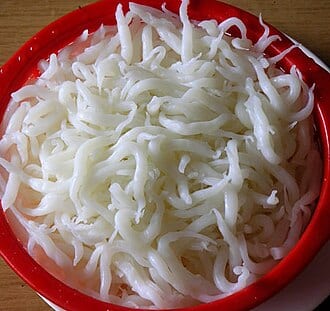
Taitung Mi Tai Mu is a rice-noodle street food made by cooking pressed indica-rice batter into short, plump strands; "Banyan Tree Mi Tai Mu" on Zhonghua Road in Taitung City has operated from its roadside-stall origins for nearly 60 years, amassing over ten thousand Google reviews averaging around 4.2 stars — a shared culinary memory for Taitung locals. The savory version comes in a bonito broth topped with crispy shallots and chives, while the sweet version is served in black-sugar shaved ice with red and mung beans; both the savory and sweet camps have loyal followings.
Banyan Tree Mi Tai Mu has operated from its roadside-stall origins for nearly 60 years and has accumulated over ten thousand Google reviews averaging around 4.2 stars; it is listed as an official recommended shop on the Taitung County Government's tourism website and is located on Zhonghua Road in Taitung City. The business has recently passed to the second generation, Huang Bofu and Liao Tingyi, who also opened a second branch under the "Xiaoman Yusheng" brand on Zhejiang Road.
What is Taitung Mi Tai Mu?
Mi tai mu is a rice-based noodle made by pressing soaked indica-rice batter through a mold and cooking it into short, plump strands — slippery, mildly fragrant, found in both Hakka and Minnan traditions with slight variations in technique. Taitung mi tai mu comes in two main styles: the savory version uses a bonito or pork-bone broth as the base, topped with crispy shallots, chive pieces, braised pork sauce, and bean sprouts — served hot as a full meal; the sweet version is placed in black-sugar water or shaved ice, paired with red beans, mung beans, or taro balls as a summer dessert. The most iconic shop is "Banyan Tree Mi Tai Mu" on Zhonghua Road, offering savory, sweet, cold, and hot in one go.
Why Taitung? In Taitung's early agricultural society, abundant indica rice made mi tai mu a natural common-folk food throughout the Hualien–Taitung region. The Banyan Tree shop grew from a roadside stall and has held firm for nearly sixty years — making mi tai mu fresh every day — accumulating over ten thousand Google reviews averaging around 4.2 stars, a shared memory for Taitung locals from childhood. Several other long-established mi tai mu shops operate along Zhonghua Road; Banyan Tree is not the only one, and the category and neighborhood are the real draw.
How to eat it the authentic way
Local knowledge
Verified sources (sponsored content filtered)
- Banyan Tree Mi Tai Mu has operated for nearly 60 years from its roadside-stall origins — a shared memory for Taitung locals.
- Accumulated over ten thousand Google reviews averaging around 4.2 stars — reputation built on mass public feedback, not a single media endorsement.
- Several long-established mi tai mu shops operate side by side on Zhonghua Road, with dedicated followings for both the savory and sweet styles.
Practical tips
- Queuing into the street at weekend lunchtime is normal. Try going in the early-to-mid afternoon lull instead.
- Order savory and sweet separately — don't mix toppings into one bowl, as the flavors will clash.
- The other long-established mi tai mu shops along Zhonghua Road are also worth trying. Don't assume Banyan Tree is the only option.
Data compiled from the Taitung County Government Department of Transportation and Tourism Development, township and village farmers' associations, and large-scale public reviews. Sponsored listings have been filtered out.
Frequently Asked Questions
What is mi tai mu made from?
It's a rice noodle made by pressing indica-rice batter and cooking it into short, plump strands, with a slippery texture and mild rice fragrance; Hakka and Minnan versions differ slightly in technique.
Should Taitung Mi Tai Mu be eaten savory or sweet?
There's no rule — the savory version in bonito broth with crispy shallots and chives works as a full meal, while the sweet version in black-sugar shaved ice is a cooling dessert; it's best to order them separately rather than mixing toppings.
How long has Banyan Tree Mi Tai Mu been open?
It has operated from its roadside-stall origins for nearly 60 years and has accumulated over ten thousand Google reviews averaging around 4.2 stars.
Is Banyan Tree the only mi tai mu shop on Zhonghua Road?
No — several other long-established mi tai mu shops operate on Zhonghua Road as well; Banyan Tree is simply the most well-known of them.
Sources
- 榕樹下米苔目 | 台東觀光旅遊網 — 台東縣政府官方旅遊網收錄店家資訊
- 台東美食|榕樹下米苔目 小雨滿生.在地50年傳統老店 — Google評論1萬則、4.2星、第二代接手等細節