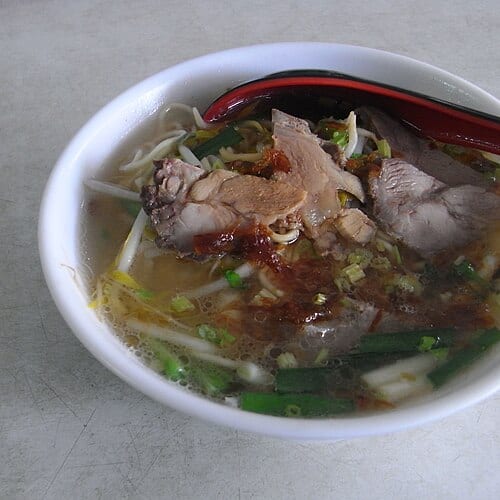
Yuli Noodles are a firm, springy hand-made oil noodle dish from Yuli Township in Hualien's Rift Valley, chewier and more resistant to overcooking than ordinary oil noodles. Heading south along the Rift Valley, Yuli is Hualien's second-largest town. Stepping off the train and out of the station, noodle shop signs on the street almost uniformly read "Yuli Noodles." Lifting a pot lid inside reveals golden-yellow noodles coiled in small mounds on bamboo trays — looking like an oversized version of Cantonese-style egg noodles, but the moment you bite in, that firm, springy chew tells you this is something else entirely.
Yuli Noodles trace back to the Japanese colonial era, when local Japanese settlers brought noodle-making culture to the area; after WWII, a Fuzhou-origin cook set up a stall selling a firm, chewy hand-made noodle resembling oil noodles, building the dish's reputation. Yuli Township today still has 4 traditional noodle-making workshops and more than 10 noodle shops serving this local dish; the long-running Asen Noodle Shop has accumulated over 3,000 Google reviews.
What are Yuli Noodles
Yuli Noodles are yellow in appearance and resemble oil noodles, but their texture is springier and more resistant to overcooking. The traditional method involves repeatedly pressing the dough, coating it with a little cooking oil to prevent sticking, then cutting into medium-thick strands; before serving, they are blanched and drained. Two main ways to eat them: dry-tossed with lard, crispy shallots, and soy paste, topped with garlic chives or bean sprouts; or in soup with pork bone broth and braised pork sauce. A bowl costs just coins and fills you up — the staple Yuli locals eat from breakfast through late-night supper.
Why are they called Yuli Noodles? The official page of the Hualien County Government's Hakka Affairs Department records that Yuli Noodles originated from a blend of Japanese noodle-making techniques from the colonial era and the craftsmanship of Fuzhou-origin cooks who arrived after World War II, taking root in Yuli — a key railway hub where people converged in the Rift Valley — and gradually developing a place-specific name. Asen Noodle Shop has over 3,000 Google reviews; Qiaotou Noodle Shop has been operating for half a century; multiple old shops coexist in town; and Wikipedia has a dedicated entry on them, cementing "Yuli Noodles" as a geographically identified local snack.
How to eat them the authentic way
Local know-how
Verified endorsements (ad-free)
- The Hualien County Government Hakka Affairs Department officially records the origin of Yuli Noodles, noting their fusion of Japanese colonial noodle techniques and postwar Fuzhou culinary craft.
- Asen Noodle Shop has over 3,000 Google reviews, combining strong local appeal with traveler acclaim.
- Wikipedia has a dedicated entry for "Yuli Noodles," establishing it as a geographically identified local snack of the Hualien Rift Valley.
Practical tips
- Yuli's Qiaotou old shop has both a 24-hour location and time-limited-hours locations — check the specific operating hours before you go.
- Yuli is about 1.5 hours from Hualien City by car; combine the trip with Antong Hot Springs or Chike Mountain to make the journey worthwhile.
- Most shops are cash-only; mobile payments may not work, so bring change.
Data compiled from Hualien County Government Tourism Department, local township farmers' associations, and large-scale public reviews; sponsored content has been filtered out.
Frequently Asked Questions
How is Yuli Noodles different from ordinary oil noodles?
Yuli Noodles look similar to oil noodles but are firmer and springier due to repeated pressing and a pre-boil-and-drain step that keeps them from turning mushy.
What's the authentic way to order Yuli Noodles?
Locals typically order one bowl of dry noodles tossed in lard and shallots plus one bowl of clear soup with braised pork to cut the richness.
How many shops still sell Yuli Noodles in Yuli Township?
Yuli Township is currently home to about 4 traditional noodle-making workshops and more than 10 noodle shops still serving the dish.
Sources
- 玉里麵-花蓮縣政府客家事務處 — 起源沿革(日治麵食技法、戰後福州師傅)
- 玉里麵-維基百科 — 現存製麵廠與麵店數量
- 傳統美食玉里麵.阿森麵店-樂活的大方 — Google評論數超過3,000則