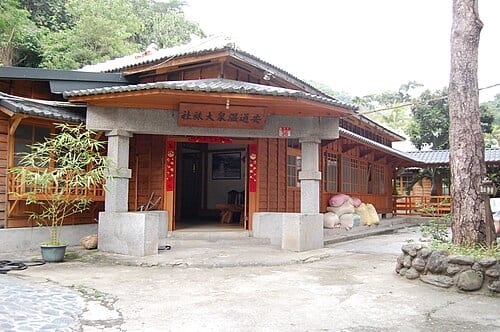
Antong Hot Springs is a hot spring area beside Antong Creek in Yuli Township, Hualien County, discovered in Meiji 37 (1904) by a Japanese camphor prospector. The spring is chloride-sulfate type with more than 15 minerals, at approximately 60 to 70 degrees Celsius; a cypress-wood police guesthouse was built here in Showa 5 (1930) and is now listed as a Hualien County historic building.
Antong's hot spring source was discovered in Meiji 37 (1904) by a Japanese camphor worker; the all-cypress police guesthouse was built in Showa 5 (1930) and is now a Hualien County historic building. The spring is chloride-sulfate type with over 15 minerals, at roughly 60 to 70 degrees Celsius. Fact-checking corrects an earlier claim that the guesthouse was built in 1906 — the verified year is 1930.
Highlights of Antong Hot Springs
Antong Hot Springs lies in the mountain area to the southeast of Yuli Township, reached by following Antong Creek upstream through intact forest into a quiet valley. The spring was discovered early and caught the attention of Japanese colonial authorities from the outset — in Meiji 39 (1906), a police guesthouse was established here, built from cypress wood in a Japanese bungalow style that has endured to the present. The quality of the architecture's preservation gives a clear sense of the historical context of mountain forest administration at that time.
Antong's spring water is sulfate type, clear and translucent, containing minerals including calcium, magnesium, and sulfate. The temperature is high (approximately 66°C) and must be diluted with cold water before bathing; after soaking, skin feels slightly smooth. Lodging nearby is mostly styled as Japanese garden retreats with hot spring facilities, creating a serene environment well suited to visitors seeking quiet, restorative experiences.
How to Make the Most of Your Visit
Practical Information
Getting There & Time
- From Yuli Township, follow signs along the Antong Creek direction. The road is a single-lane mountain track with some sections requiring careful passing of oncoming vehicles. Large tour coaches are not recommended.
- The springs can be visited year-round. Autumn and winter (October to February of the following year) bring cooler valley temperatures, making the therapeutic effect of the hot springs most pronounced.
- Lodging reservations are strongly recommended, especially during holiday periods when availability is limited.
Nearby Connections
- Antong Hot Springs is approximately 15 to 20 minutes by car from Yuli Town, and can be combined with a visit to the Yuli Tectonic Plate Suture Zone Monument or the town center.
- To the south, the route can extend to Liushidan Mountain in Fuli Township or Luoshan Waterfall, completing a full southern rift valley itinerary.
Sources: Hualien County Cultural Affairs Bureau historic building registration data, Yuli Township Office tourism information.
Frequently Asked Questions
When was Antong Hot Springs discovered?
It was discovered in 1904 by a Japanese camphor prospector.
When was the cypress guesthouse built?
The all-cypress police guesthouse was built in 1930 and is now a Hualien County historic building.
What type of spring is Antong?
It is chloride-sulfate type, with more than 15 minerals, at roughly 60 to 70 degrees Celsius.
Sources
- 安通溫泉旅舍 - 花蓮縣文化局 — 記載溫泉發現於明治37年(1904)、警察招待所建於昭和5年(1930)
- 安通溫泉 - 花蓮觀光資訊網 — 記載泉質為氯化物硫酸鹽泉、泉溫約66度、含15種以上礦物質