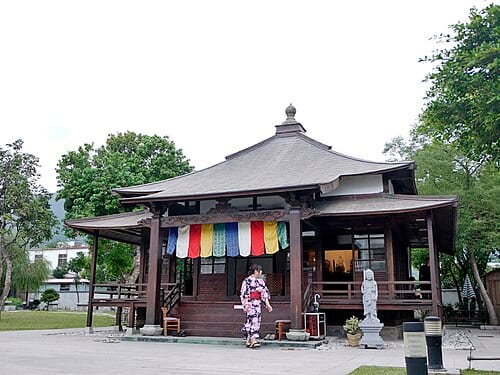
Qingxiu Temple is a Japanese-style Buddhist temple in Ji'an Township, Hualien County, built in 1917 as the Yoshino Mission Station and designated a Hualien County historic monument in 1997.
Qingxiu Temple was built in 1917 (Taisho 6) through fundraising by Kawabata Mitsuji, originally named the Yoshino Mission Station and dedicated to Fudo Myoo. It was designated a Hualien County historic monument on April 1, 1997, and reopened to the public after a full restoration completed in August 2003. The 88 stone Buddha statues on the grounds are arranged after Japan's Shikoku 88-temple pilgrimage.
Highlights of Qingxiu Temple
Qingxiu Temple was built by Japanese immigrant worshippers who had settled in Yoshino (present-day Ji'an Township), bearing witness to the history of Japanese agricultural migration to the Hualien Plain. The Yoshino immigrant village was one of the largest Japanese agricultural settlement communities in eastern Taiwan at the time, and Qingxiu Temple served as its religious center. After 1945, the Japanese settlers returned to Japan and the temple passed into the hands of Han Taiwanese worshippers, who maintained it through a series of restorations.
The eighty-eight stone Buddhas inside the grounds are arranged according to the configuration of the eighty-eight sacred sites of the Shikoku Pilgrimage in Japan; walking the full circuit symbolically represents completing the Shikoku henro pilgrimage. The timber main hall, lined approach of stone lanterns, temizuya (water ablution pavilion), and other spatial elements are all present and complete, faithfully reproducing the spatial sequence of a Shingon Buddhist temple. Visit with a quiet and respectful demeanor — do not touch the stone Buddhas or religious artifacts.
Tips for Getting the Most Out of Your Visit
Practical Information
Getting There & Time
- Located along Zhongxing Road in Ji'an Township, about a 10–15-minute drive from Hualien City, or take a bus to Ji'an Station and walk from there.
- Opening hours and visitor rules should be confirmed with the temple or the Cultural Heritage Bureau, Ministry of Culture. As a national historic site, visitor access prioritizes preservation, and some areas may have restrictions.
- Allow 45 to 60 minutes, including the stone Buddha circuit and the main hall visit.
Nearby Connections
- Ji'an Township has several Amis cultural sites nearby. Check with local tourism information for indigenous cultural experience programs that can be combined.
- Not far from Hualien City — can be paired with East Gate Night Market or Songyuan Villa for a half-day Hualien city itinerary.
Sources: National Historic Site database, Cultural Heritage Bureau, Ministry of Culture.
Frequently Asked Questions
When was Qingxiu Temple built?
Qingxiu Temple was built in 1917 through fundraising by Kawabata Mitsuji.
Is Qingxiu Temple a national or county historic site?
It was designated a Hualien County historic monument in 1997, not a nationally designated site.
What is the origin of the 88 stone Buddha statues?
They are arranged after Japan's Shikoku 88-temple pilgrimage, and walking the circuit symbolizes completing the pilgrimage.
Sources
- 慶修院 - 維基百科 — 建造年份、創建人、古蹟等級(縣定古蹟)與公告日期
- 吉安慶修院 - 文化部文化資產局國家文化資產網 — 官方古蹟登錄資料