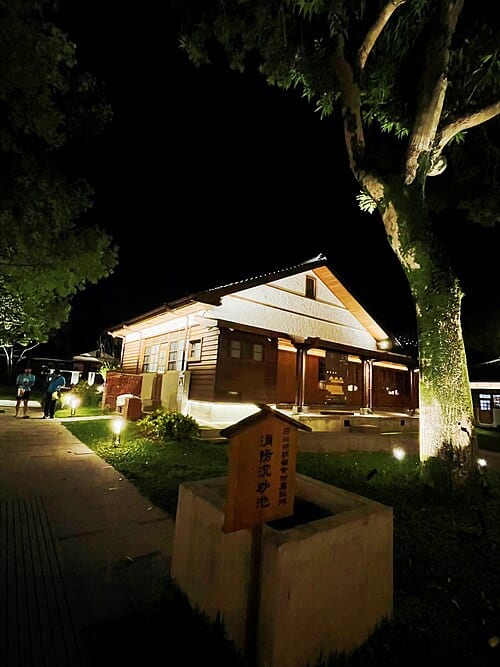
Jiangjun Mansion is a Japanese-style hinoki-cypress official residence beside Meilun River in Hualien City, built in 1936 for Colonel Nakamura, the highest-ranking military commander in the Hualien area at the time, and now designated a Hualien County historic monument.
Jiangjun Mansion was built in 1936 (Showa 11) as the official residence of Colonel Nakamura, the highest-ranking military commander in the Hualien area at the time, constructed of Taiwan hinoki cypress. It is now designated a Hualien County historic monument, while seven surrounding buildings in the same Meilun riverside Japanese dormitory complex are registered as historic buildings; the complex closed for renovation in 2020 and reopened in 2024.
Highlights of Jiangjun Mansion
Taiwan hinoki is the primary building material throughout — the timber frame, sliding door layout, raised floorboards, and engawa (veranda corridor) all reflect the typical construction of a Japanese single-story residence. The perimeter wall and stone steps define the courtyard boundaries, and while the garden planting has aged, the original layout remains legible. Compared to public office buildings of the same era, official residences like this one were held to higher standards in terms of material quality and spatial scale, making this an informative case study for observing Japanese colonial residential culture.
Jiangjun Mansion sits beside Meilun River in a quiet setting that stands in sharp contrast to the busy city center. Because it is far less well known than the nearby Songyuan Villa, visitor numbers are relatively low, making it easier to slow down and absorb the building's historical atmosphere. Visitors with an interest in Japanese colonial architecture or modern Taiwanese history will find this well worth including in the same day's itinerary for a closer look.
Tips for Getting the Most Out of Your Visit
Practical Information
Getting There & Time
- Located beside Meilun River in Hualien City, about 1.5 to 2 km from Hualien Station — accessible on foot or by bicycle.
- For opening hours and whether a reservation is required, check the latest announcements from Hualien City Office or the relevant cultural authority.
- Allow 40 to 60 minutes, including the garden and a closer look at the building's details.
Nearby Connections
- About 1 km from Songyuan Villa — walkable or bikeable, forming a Japanese colonial architecture themed route within Hualien City.
- The Meilun River cycling path is nearby; follow the riverside route to Hualien Port for an extended coastal scenery experience.
Sources: Cultural Heritage Bureau, Ministry of Culture; Hualien City Office.
Frequently Asked Questions
When was Jiangjun Mansion built?
Jiangjun Mansion was built in 1936 out of Taiwan hinoki cypress.
Who originally lived in Jiangjun Mansion?
It originally served as the residence of Colonel Nakamura, the highest-ranking army commander in the Hualien area.
What is Jiangjun Mansion's current heritage status?
It is now designated a Hualien County historic monument, while seven neighboring buildings are registered as historic buildings.
Sources
- 將軍府(美崙溪畔日式宿舍) - 花蓮觀光資訊網 — 建造年份、指揮官姓名、古蹟等級(縣定古蹟)
- 花蓮免門票【將軍府1936園區】歷史建築活化再生 — 宿舍群封閉整修與2024年重新開放