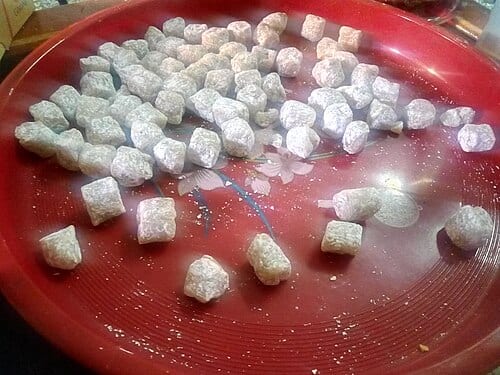
Xingang Candy is a century-old maltose-and-peanut confection from Xingang Township, Chiayi County, first created in 1891 by candy vendor Lu Ci-tou in nearby Minxiong; originally called 'mouse candy' or 'shuang-ren-run,' it was renamed Xingang Candy after Lu relocated his stall to the square in front of Xingang Fengtian Temple — a lineage now spanning more than 130 years.
Xingang Candy originated in 1891 (the 17th year of the Guangxu reign), invented by Minxiong-based candy vendor Lu Ci-tou, originally named 'mouse candy' or 'shuang-ren-run.' During that year's lunar 3/23 Mazu temple fair, Lu relocated his stall to the square in front of Xingang's Mazu temple; strong sales among the crowds of pilgrims led him to rename the product 'Xingang Candy' and put up the 'Jin Chang Li' shop sign (per the Chinese Wikipedia entry on Xingang Candy). The confection now has a lineage of more than 130 years and has traditionally been used as a wedding candy in Taiwan.
What is Xingang Candy
Xingang candy is made from a maltose base blended with peanuts, hand-pulled into strips or blocks. The exterior is coated with toasted peanut powder; the texture is springy and non-sticky, with moderate-to-low sweetness and a prominent peanut aroma. Traditional flavors include plain, sesame, and red bean; some shops have in recent years introduced matcha and brown sugar varieties, though the traditional flavors remain the most dependable choice. Refrigeration extends shelf life, but the flavor is best at room temperature.
Xingang candy has been made in Xingang Township for over a century, originally circulated as a temple fair gift and pilgrim souvenir. The large-scale pilgrimage events held annually at Xingang Fengtian Temple drive tourist traffic, and several candy shops along Zhongshan Road developed as a result, each with its own history and recipe lineage. The production process centers on cooking maltose and hand-pulling it, which limits output — stocking up early during peak seasons is advisable.
How to eat it the local way
Local knowledge
Verified background
- Xingang candy is a traditional hand-pulled maltose-and-peanut confection from Xingang Township, Chiayi County, with over a century of history and a complete cultural record.
- Xingang Fengtian Temple is one of Taiwan's major Mazu temples; Xingang candy is the top-choice souvenir for pilgrims, with a clear local cultural connection.
- Multiple candy shops along Zhongshan Road old street each have their own inherited recipes, positioning their products as everyday local sweets rather than tourist novelties.
Practical notes
- Crowds are extremely large around temple fair festivals; queuing is required during peak season. Non-festival weekdays are recommended for a more relaxed visit.
- Imitation products are widely available on the market. Buying directly from established shops on Zhongshan Road old street is recommended to ensure an authentic recipe.
- Shelf life varies by packaging — check the production date at time of purchase. Store at room temperature away from heat and direct sunlight to prevent the candy from melting.
Sources: Xingang Township local food culture records, survey of commercial district around Fengtian Temple.
Frequently Asked Questions
When was Xingang Candy invented?
It was created in 1891 by Minxiong candy vendor Lu Ci-tou, originally called 'mouse candy.'
How did it get its name?
After Lu moved his stall to the square in front of Xingang's Mazu temple and business boomed during the temple fair, he renamed the sweet 'Xingang Candy.'
What are the traditional flavors?
The traditional flavors are plain peanut, sesame, and red bean, with a springy, non-sticky texture.
Sources
- 新港飴 — 創始年份1891、創始人盧欺頭、原名鳥鼠仔糖/雙仁潤
- 始於清光緒年間、與奉天宮齊名的「新港飴」!新港人的集體記憶百年老店金長利 — 金長利老店沿革
- 日本天皇也愛吃!嘉義新港伴手禮「新港飴」,舊名叫做「老鼠糖」 — 新港飴歷史背景報導