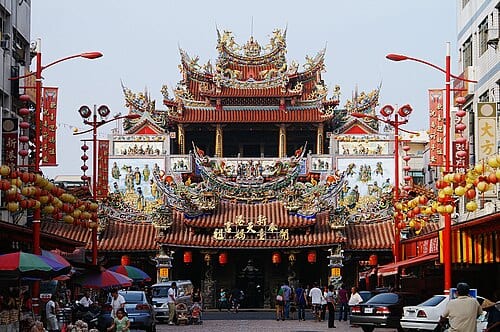
Xingang Fengtian Temple is a Mazu temple in Xingang Township, Chiayi County, whose founding legend traces back to 1622, when a ship owner is said to have brought a Mazu statue from Meizhou ashore at Beigang. The existing temple structure, rebuilt several times over the centuries, was completed and named “Fengtian Temple” in 1811 (the 16th year of the Jiaqing era), and was designated a county-level historic monument in 1985. Each year in late lunar February to early March, the nine-day Dajia Mazu pilgrimage from Taichung's Zhenlan Temple concludes here, making it the site of one of Taiwan's largest collective displays of folk faith.
According to the temple's own account, in 1622 (the 2nd year of the Ming Tianqi era) a ship owner named Liu Dingguo brought a Mazu statue from Meizhou ashore at Beigang; local residents then built the Tianfei Temple there in 1700 (the 39th year of the Kangxi era). After a flood destroyed the temple in 1799, it was rebuilt and completed in 1811 (the 16th year of the Jiaqing era) under the name “Fengtian Temple,” and in 1985 the Ministry of the Interior designated it a Class 3 historic monument (now a county-level monument). Every year, the nine-day, eight-night Dajia Mazu pilgrimage from Taichung's Zhenlan Temple — a roughly 340-kilometer round-trip walk — concludes at Xingang Fengtian Temple, making it one of Taiwan's largest religious procession events.
Highlights of Xingang Fengtian Temple
Xingang Fengtian Temple was originally established during the Tianqi era of the Ming dynasty (around 1622) and has undergone renovations and expansions in every subsequent era. The existing structure is imposing in scale. The architecture combines mosaic-chip appliqué (jiǎnniān), Jiaozhi ceramics (jiāozhǐ táo), wood carving, and stone carving in a single complex, with the roof ridge decorations of the main hall being particularly outstanding — an important example of traditional Taiwanese temple architectural art. The temple houses numerous valuable artifacts and records of successive renovations, bearing witness to four centuries of faith.
The lunar-March Mazu pilgrimage procession is a massive undertaking: devotee contingents set out from all parts of Chiayi County, accompanied by gongs and drums, drum troupes, ceremonial sedan chairs, and decorated floats that build to a climax on arriving at Fengtian Temple. The temple forecourt draws worshippers and pilgrims on a daily basis, and the surrounding area is packed with street food stalls. The nougat candy (láo táng / làozǐ) from Xingang Township is a well-known local souvenir, and the commercial activity around the temple is lively.
How to Make the Most of Your Visit
Practical Information
Getting There & Hours
- Xingang Township is in northwestern Chiayi County, about a 20-minute drive from Chiayi city; by public transit, take a highway bus to the Xingang stop.
- The temple is open year-round. Road closures are in effect around the temple during the lunar-March procession; public transit or arriving early is recommended.
Nearby Connections
- Yunlin's Beigang Chaotian Temple is near the county border, about a 15-minute drive away — plan a cross-county Mazu cultural itinerary.
- Chiayi County's Dongshi Fisherman's Wharf is on the coast; combine it with Xingang for a half-day land-and-sea tour of western Chiayi.
Source: Public historical records from the temple and religious-culture literature.
Frequently Asked Questions
When was Xingang Fengtian Temple built?
Temple records trace a 1622 legend of a Mazu statue arriving at Beigang, but the existing temple structure was actually rebuilt and completed in 1811.
Is Xingang Fengtian Temple a protected historic site?
Yes — it was designated a Class 3 historic monument by Taiwan's Ministry of the Interior in 1985 and is now listed as a Chiayi County monument.
Why is Xingang Fengtian Temple linked to the Dajia Mazu pilgrimage?
Every year Taichung's Dajia Zhenlan Temple holds a nine-day, eight-night Mazu pilgrimage covering a roughly 340-kilometer round trip on foot, and the procession concludes at Xingang Fengtian Temple — one of Taiwan's largest Mazu pilgrimage events.
Does Xingang Fengtian Temple hold its own procession?
Yes — it holds a separate eight-day, seven-night Lantern Festival procession each lunar January 15th, covering Xingang and neighboring townships, distinct from the Dajia pilgrimage.
Sources
- 新港奉天宮-維基百科 — 建廟沿革與古蹟公告年份
- 大甲媽祖遶境進香-維基百科 — 九天八夜遶境路線與終點新港奉天宮