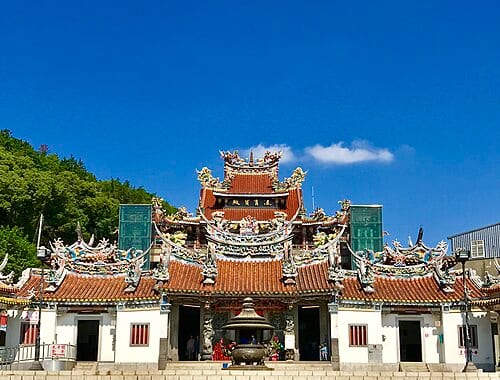
Shoushan Rock Guanyin Temple is a Qing-dynasty temple in Guishan District, Taoyuan, dedicated to Guanshiyin Bodhisattva. Tradition holds that a monk brought a Guanyin statue from Mount Putuo, Zhejiang, in 1742, and the temple was formally built in 1797 with funding from Qing naval commander Hada'a; it is now designated a Taoyuan municipal historic site. Built against the Guishan hillside, its back hill is planted mainly with Taiwan cherry and a small number of Yoshino cherry trees that draw large crowds from late January to March, while the lotus pond and forecourt form a complete traditional Minnan temple layout.
According to Wikipedia and Taoyuan cultural heritage records, tradition holds that a monk brought a Guanyin statue from Mount Putuo, Zhejiang, to the site in 1742 (the 7th year of the Qianlong reign), while the temple itself was formally built in 1797 with funding from Qing naval commander Hada'a; it was officially designated a Taoyuan municipal historic site on August 19, 1985. The cherry grove on the back hill consists mainly of native Taiwan cherry trees, with only a small number of Yoshino cherries, blooming roughly from late January to March.
Highlights of Shoushan Rock Guanyin Temple
Shoushan Rock Guanyin Temple was built during the Qing dynasty and has undergone several expansions. The existing buildings blend construction methods from different periods while retaining multiple traditional Minnan temple architectural elements, including the complete layout of the sānchuān diàn (front hall), main hall, and rear hall. The temple tiers up along the hillside, with the building heights rising and falling with the terrain to create a dramatic sense of depth. The wooden painted murals and stone carvings on the historic structure carry considerable cultural relic value.
In spring (approximately late February to mid-March), the Yoshino cherry trees on the back hill are in full bloom, with pale pink-white petals set against the ancient temple rooflines in a striking contrast — one of the most visually impactful cherry blossom viewing spots in the greater Taoyuan area. The lotus pond in front of the temple is at its best in summer (approximately June to September) when the lotuses bloom, offering another seasonal natural landscape to look forward to. Checking the bloom forecast for the year before visiting is recommended, as temperatures influence flowering times and dates vary slightly each year.
How to Make the Most of Your Visit
Practical Information
Getting There & Timing
- Located on Wanshou Road in Guishan District. Accessible by car with parking available. During cherry blossom season, weekend parking is in short supply — departing early or taking public transport is recommended.
- The temple is open at all times with no admission fee. During spring cherry blossom season there are large crowds; weekday visits or morning visits are recommended to avoid the most crowded midday hours on weekends.
Nearby Connections
- Guishan District is close to the Taoyuan city area — the itinerary can be extended to include Old Laolao Creek River Corridor or Taoyuan Museum of Fine Arts.
- The Linkou Plateau and Guishan hill trail system are options for additional outdoor activity, suitable for visitors who enjoy hiking.
Sources: Ministry of Interior historic sites database, Taoyuan City Government Tourism Bureau.
Frequently Asked Questions
When was Shoushan Rock Guanyin Temple built?
Tradition holds the Guanyin statue was enshrined here in 1742, while the temple building itself was formally completed in 1797, making it one of Taoyuan's oldest surviving temples.
What heritage status does the temple hold?
It is designated a Taoyuan municipal historic site, officially listed on August 19, 1985.
When is the best time to see the cherry blossoms on the back hill?
The bloom runs roughly from late January to March, with native Taiwan cherry flowering first and a small number of Yoshino cherries following.
Sources
- 壽山巖觀音寺 - 維基百科 — 建廟沿革(1742年迎觀音、1797年建廟)與古蹟指定年份
- 壽山巖觀音寺官網 — 官方沿革資料