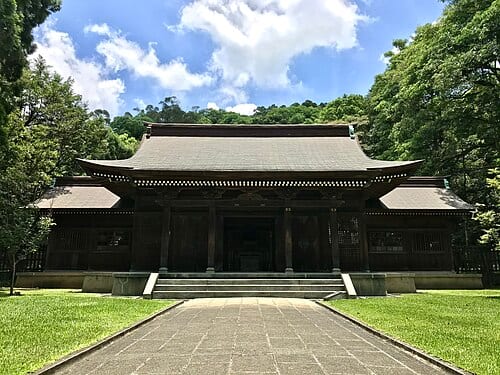
Taoyuan Martyrs' Shrine and Shrine Cultural Park is a shrine complex at the foot of Hutou Mountain in Taoyuan District, converted from the Japanese-era Taoyuan Shrine. The shrine held its completion and enshrinement ceremony on June 10, 1938, was repurposed as a martyrs' shrine in 1946 after the war, and was registered as a historic monument on February 15, 1994 (originally a national third-grade monument, now a Taoyuan City municipal historic site). Core Shinto architectural elements — the torii gate, approach path, ablution pavilion, worship hall, and main hall — are largely preserved, making it one of the most intact examples of Japanese shrine construction techniques in Taiwan.
The original Taoyuan Shrine held its completion ceremony on June 10, 1938; after the war it was repurposed as Hsinchu County Martyrs' Shrine in 1946, then renamed Taoyuan County Martyrs' Shrine in October 1950 following an administrative boundary change. It was registered as a historic monument on February 15, 1994 (originally a national third-grade monument, now a Taoyuan City municipal historic site), and is considered a landmark case that helped spur subsequent heritage protection of other Japanese-era shrine buildings in Taiwan.
What to See at Taoyuan Martyrs' Shrine and Shrine Cultural Park
Most Shinto shrines built during the Japanese colonial period in Taiwan were demolished or extensively rebuilt after the war. Taoyuan Shrine was relatively well preserved because its repurposing as a martyrs' shrine retained the Shinto architectural vocabulary intact. Entering from the torii gate along the approach path, visitors encounter in sequence the temizuya (water basin for hand-washing), the rows of stone lanterns, the worship hall, and the main hall. The overall spatial sequence is clear and reflects the designed logic of the Shinto worship approach. The buildings are constructed of hinoki cypress, with a kirizuma-zukuri (hip gable) roof form.
The park simultaneously functions as a martyrs' shrine, enshrining the spirit tablets of those who died defending Taiwan. It thus bears a dual character as both a Shinto architectural remnant and an active religious site. When visiting, take time to observe the formal elements of Japanese shrine architecture: the proportional column ratio of the torii, the way the shimenawa rope is hung, the stone craftsmanship of the temizuya, and other details. The park shares its Chenggong Road entrance with the adjacent Hutou Mountain Park, and the two can be planned for a same-day visit.
How to Make the Most of Your Visit
Practical Information
Getting There & Time
- From Taoyuan Train Station, take a local bus to Section 3, Chenggong Road; it is about a 10 to 15 minute walk to the park entrance. YouBike is also an option.
- The park is open all day with no admission fee; special ceremony dates follow the martyrs' shrine's announcements.
Nearby Connections
- Adjacent to Hutou Mountain Park — plan the shrine visit followed by the Hutou Mountain trail hike and summit viewpoint.
- Taoyuan City center has several Japanese-era historic buildings; this visit can be extended into a walking tour of historical architecture in the old Taoyuan city district.
Sources: Bureau of Cultural Heritage, Ministry of Culture, historic site data.
Frequently Asked Questions
When was the original Taoyuan Shrine built?
It held its completion and enshrinement ceremony on June 10, 1938, part of the Japanese colonial government's policy of building shrines across Taiwan.
When was it converted into a martyrs' shrine?
After the war it became Hsinchu County Martyrs' Shrine in 1946, then was renamed Taoyuan County Martyrs' Shrine in October 1950 following an administrative boundary change.
When was it designated a historic monument?
It was registered on February 15, 1994, originally as a national third-grade monument, now reclassified as a Taoyuan City municipal historic site.
Sources
- 桃園忠烈祠 - 維基百科 — 興建、改制、古蹟登錄年份
- 法定文化資產-桃園神社(忠烈祠) — 桃園區公所官方頁面,交叉核對1994年2月15日登錄日期