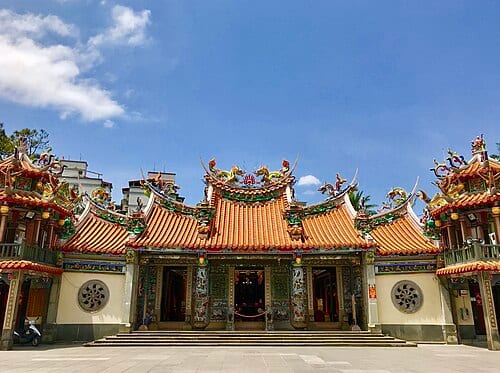
Pingzhen Baojhong Shrine (Yimin Temple) is a Hakka religious temple in Pingzhen District, Taoyuan, dedicated to Yimin Ye (the Righteous Martyrs) and founded in 1791 (the 56th year of the Qianlong reign), originally named the Yimin Pavilion. Because travel to Xinpu in Hsinchu was difficult for early believers, communities across Zhongli, Pingzhen, and Yangmei developed their own rotating "Thirteen Grand Townships" worship circle, co-led by Zhongli Renhai Temple and Pingzhen Baojhong Shrine, independent of — though spiritually tracing back to — Xinpu Baojhong Temple in Hsinchu. Every year during the seventh lunar month's Yimin Festival, sacred pig competitions and cultural events draw large numbers of Hakka devotees, making it one of the most important religious centers for Hakka communities in southern Taoyuan.
Pingzhen Baojhong Shrine was founded in 1791 (the 56th year of the Qianlong reign), originally named the Yimin Pavilion. Because early transportation was inconvenient, believers in Zhongli, Pingzhen, and Yangmei developed a Thirteen Grand Townships rotating worship circle independent of Xinpu Baojhong Temple in Hsinchu, co-led by Zhongli Renhai Temple and Pingzhen Baojhong Shrine, which trace their spiritual origin to Xinpu Baojhong Temple but operate autonomously. The current structure was rebuilt between 1949 and 1951, facing southeast with a floor area of about 308.75 ping (roughly 1,019 square meters).
What to See at Pingzhen Baojhong Shrine
Yimin Ye, enshrined at Yimin temples, are the Hakka militia fighters who died during the Lin Shuangwen Incident of the Qianlong era. Their worship is rooted in the historical memory of Hakka migrants defending their homelands. Taiwan's Hakka community Yimin temple worship alliance is a rare trans-regional joint festival organization, with multiple villages taking turns hosting the Yimin Festival on a rotating basis, forming a close social network. As the Yimin temple for the Taoyuan region, Pingzhen Baojhong Shrine has long served as a symbolic site of local Hakka identity.
The temple's architectural layout is typical, with a main gate hall, main hall, and rear hall. The main hall enshrines the Yimin Ye spirit tablet. On ordinary days, incense-offering visitors and local residents come and go through the temple forecourt — a setting for observing the daily operations of a traditional Taiwanese temple. During the Yimin Festival in the seventh lunar month (approximately August to September in the solar calendar), activity around the temple intensifies, sacred pig competitions are held on a large scale, and visitor numbers increase substantially over the norm.
How to Make the Most of Your Visit
Practical Information
Getting There & Time
- Taoyuan city buses serve Pingzhen District; bus routes run from both Zhongli and Taoyuan Train Stations. Check the latest route schedules.
- The shrine is open all day. During the Yimin Festival (seventh lunar month), traffic in the surrounding area may be congested; allow extra time.
Nearby Connections
- Pingzhen District has several Hakka culture-related attractions and restaurants that can be developed into a southern Taoyuan Hakka culture half-day itinerary.
- Combine with attractions in Zhongli urban area or toward Longtan to form a complete southern Taoyuan Hakka route.
Sources: Bureau of Cultural Heritage, Ministry of Culture, temple data; Council for Hakka Affairs, Yimin faith related materials.
Frequently Asked Questions
When was Pingzhen Baojhong Shrine founded?
It was founded in 1791, the 56th year of the Qing dynasty's Qianlong reign, originally named the Yimin Pavilion.
Does Pingzhen Baojhong Shrine belong to the same worship circle as Xinpu Yimin Temple in Hsinchu?
No — the two operate independently; believers in Zhongli, Pingzhen, and Yangmei developed their own Thirteen Grand Townships rotating worship circle due to inconvenient early transportation, tracing only their spiritual origin to Xinpu Baojhong Temple.
When is Pingzhen Baojhong Shrine at its liveliest?
During the Yimin Festival in the seventh lunar month, when sacred pig competitions and cultural events draw large numbers of Hakka devotees.
Sources
- 平鎮褒忠祠 - 維基百科 — 創建年份、十三大庄祭祀圈與新埔義民廟的獨立關係、重建規格
- 北台灣四大義民廟、南桃園市區域十三庄祭祀圈廟宇之一 — 補充歷史年份交叉核對(二百三十二年歷史)