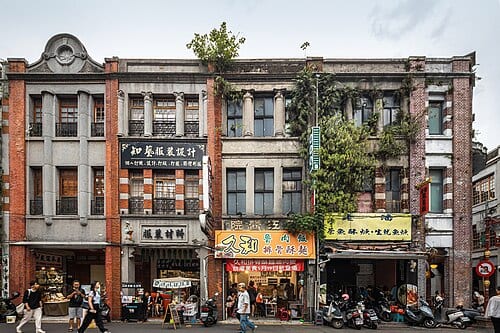
Dihua Street is one of Taipei's most intact 19th-century commercial streets, lined with Hokkien-style brick shophouses and Baroque facades. Xia Hai City God Temple, built in 1821 and now more than 200 years old, sits at the street's midpoint as the commercial and spiritual heart of Dadaocheng; the district is busiest in the weeks before Lunar New Year when it becomes a seasonal goods market.
Xia Hai City God Temple was built in 1821 and is now more than 200 years old; though its grounds cover only about 46 ping, it once housed over 600 deity statues, among the highest density in Taiwan. Watsons' Dispensary on the street, built in 1917, was Taiwan's first Western-style pharmacy building.
Highlights of Dihua Street
Dihua Street developed from the late 19th century as a commercial district in Qing-era Dadaocheng, with dried goods, traditional Chinese medicine, and fabric wholesale as its main trades. It was once an important commercial hub for Taiwan's foreign trade. During the Japanese colonial period some merchants introduced Western Baroque architectural vocabulary to renovate their facades, creating the distinctive mix of traditional Hokkien layouts and European decorative elements. Many of the buildings are now listed as historical structures.
Today, alongside traditional goods stores, Dihua Street has also gained cafes, creative shops, and design brands, forming a composite scene of old street with new uses. Xia Hai City God Temple is well-attended, with the City God as the principal deity. The temple forecourt is narrow but densely frequented. For approximately six weeks before the Lunar New Year, the entire street transforms into a seasonal goods market offering festive foods, dried goods, and nuts — one of the strongest traditional Chinese New Year atmospheres in Taipei.
How to make the most of your visit
Practical information
Getting there and time needed
- Take the MRT Songshan–Xindian Line to Beimen Station or Daqiaotou Station; it is a 5- to 10-minute walk to the northern or southern entrance of Dihua Street.
- The street is open all day. Individual shop hours vary; traditional dried goods stores tend to close relatively early in the afternoon.
- The Lunar New Year goods season runs approximately six weeks before the New Year (exact timing varies with the lunar calendar each year), and crowds increase noticeably.
Nearby connections
- Dadaocheng Wharf is a short walk along the Tamsui River. At dusk you can stroll along the riverbank and watch the sunset.
- Ningxia Night Market is nearby and makes a natural stop for traditional Taipei street food in the evening.
Source: Taipei City Cultural Bureau historical building records and public historical materials.
Frequently Asked Questions
When was Xia Hai City God Temple built?
It was built in 1821 and is now more than 200 years old.
When is Dihua Street busiest?
It is busiest during the six weeks of the Lunar New Year goods market before the holiday.
What is distinctive about Dihua Street's architecture?
A mix of Hokkien-style brick shophouses and Japanese-era Baroque building facades.
Sources
- 台北霞海城隍廟 — 創建年代與廟宇規模
- 迪化街 - 維基百科 — 街區歷史