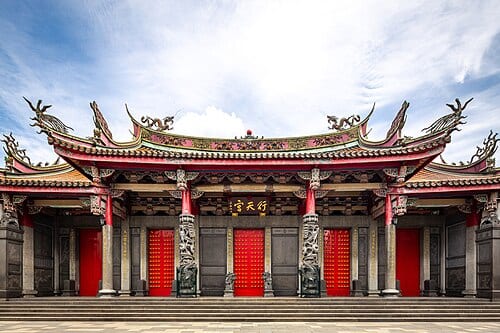
Xingtian Temple is a major Guan Di temple in Taipei, founded in 1968 and known for banning the burning of spirit money, forgoing donation boxes, and offering free spiritual-cleansing (shoujing) rituals, with a lively temple-front food stall culture nearby.
Xingtian Temple's main hall in Taipei was completed on January 25, 1968. Its founder, Huang Xuankong (born Huang Cong, 1911–1970), established a reform doctrine in 1949 prohibiting the burning of spirit money and animal sacrifice offerings. On August 26, 2014, the temple went further, removing its incense burners and offering tables to become Taiwan's first incense-free temple.
Highlights of Xingtian Temple
Xingtian Temple's principal deity is Guan Shengdijun. In Taiwanese folk religion, the Emperor Guan is regarded as the patron of commerce and righteousness, which draws a large number of business people to worship here. The temple's free counseling service is staffed by volunteers who offer guidance on life concerns at no charge; a queue of people waiting is a common sight. The temple building has a balanced layout with red walls and gold-tiled roofs. The wide forecourt in front of the main hall creates an atmosphere of incense smoke and reverence that is uncommon in central Taipei.
The temple's ban on burning spirit money has been in effect for more than 20 years, making it one of the earlier examples of a Taiwanese temple adopting eco-friendly practices. Food vendors near the temple forecourt offer a variety of traditional Taipei street foods, forming a street food culture centered on the temple — a good entry point for observing everyday Taipei life. The underground arcade beside the temple hosts small shops and food stalls that extend toward the MRT Songjiang-Nanjing Station area.
Tips for Getting the Most Out of Your Visit
Practical Information
Getting There & Time
- Take the MRT Songshan-Xindian Line or Zhonghe-Xinlu Line to Songjiang-Nanjing Station, then walk about 5 minutes.
- The temple is open daily. For exact hours, check the temple's official website. Free counseling operates on a set schedule; check in advance.
Nearby Connections
- Ningxia Night Market nearby is well known for traditional Taipei snacks; plan an evening visit. Shuanglian Morning Market is about 10 minutes away.
- The Zhongshan District's Linsen N. Road commercial area is within walking distance; shopping or dining can be added to the itinerary.
A Temple That Doesn't Burn Spirit Money: Xingtian Temple's Environmental and Religious Philosophy
Xingtian Temple does not burn spirit money, does not have a donation box, and does not offer sacrificial meats — a philosophy that traces back to founder Huang Xuankong (born Huang Cong, 1911-1970), who proposed reforms to spirit-writing altar (luantang) practice in 1949. Since the Taipei main temple was completed in 1968, it has followed this philosophy, using rice cakes and longan fruit instead of traditional offerings. Starting on August 26, 2014, the temple went further and removed its incense burners and offering tables altogether, becoming Taiwan's first temple to prohibit incense burning — a move that addresses air quality while reflecting the belief that sincerity itself is the true offering to the gods.
Emperor Guan and the Shou Jing Ritual: The Spiritual Core of Xingtian Temple
The temple's principal deity, referred to as 'Enzhu Gong' (Benefactor Lord), is Guan Shengdijun — the historical general Guan Yu (Guan Gong) from the Three Kingdoms period. The temple also enshrines Lu Dongbin, Zhang Dan, Wang Shan, and Yue Fei, together known as the 'Five Benefactor Lords'; the term 'Enzhu' comes from the spirit-writing tradition's concept of a savior deity. The temple's well-known shou jing (soul-settling) ritual traces back to the late 1940s at the Beitou Xingtiantang. In the ritual, a temple volunteer asks the worshipper's name, invokes Guan Shengdijun as the presiding deity, and waves a hand gesture, incense stick, or ritual implement around the person's body to calm an unsettled or frightened spirit.
Frequently Asked Questions
When was Xingtian Temple founded?
Xingtian Temple's Taipei main hall was completed in 1968 and is dedicated to Guan Shengdijun (Emperor Guan).
Why doesn't Xingtian Temple burn spirit money?
Founder Huang Xuankong introduced a reform doctrine in 1949 banning the burning of spirit money and animal sacrifices, a practice the temple still follows, and it removed its incense burners entirely in 2014.
Is Xingtian Temple's shoujing ritual free?
Yes — the shoujing ritual and free counseling service are performed by volunteers at no charge.
Sources
- 行天宮 - 維基百科 — 創建年份、黃玄空生平、2014年撤除香爐日期
- 行天宮五大志業網 — 官方網站