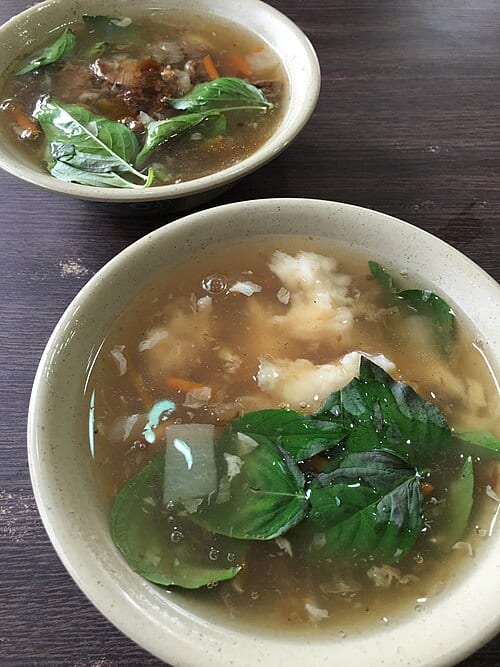
Cuttlefish thick soup is a seafood broth found at Taiwanese night markets, made with fresh cuttlefish cut into pieces or shaped from cuttlefish paste and simmered in a lightly starch-thickened broth. After dark at Ningxia Night Market, the soup pot at the hua zhi geng stall steams steadily. A ladle lifts pieces of pale, smooth cuttlefish and sets them gently into the bowl. The lightly thickened broth carries the clean sweetness of the sea. This is not the dense, heavy southern-style broth — it is the Taipei version of a seafood soup: light, refreshing, with the sweetness leading the way, letting the texture of the cuttlefish itself take center stage.
The stall zone that Ningxia Night Market occupies was officially established by the Taipei City Government in 1993, and vendors formed the registered Taipei Ningxia Night Market Tourism Association in December 2008 — confirming its status as a government-recognized traditional night market. Hua zhi geng is a commonly available seafood soup item at markets like this, typically eaten alongside oyster omelet or glutinous oil rice.
What is Cuttlefish Thick Soup
Hua zhi geng uses fresh cuttlefish either cut into pieces or shaped into balls from cuttlefish paste, cooked in a broth made from pork bones or seafood, with sweet potato starch or tapioca starch added for a light thickening. Bamboo shoots and vegetables are included as well. The Taipei version uses a minimal ratio of starch, leaving the broth clear and flowing. The cuttlefish is silky and springy, and the seafood sweetness comes through cleanly without being masked. Compared to the denser, stickier versions from Tainan or Yunlin, this style is light and sits closer to an everyday soup than to a heavy night market dish.
Hua zhi geng is a standard seafood soup item at Taiwan night markets, forming a trio with oyster soup and fish soup as the three main night market broths. Ningxia Night Market is a well-known market in Datong District in the old city of Taipei, celebrated for traditional Taiwanese snacks. The share of local regulars here is higher relative to the tourist-heavy Shilin Night Market, which means the food style retains more of the northern Taiwanese traditional character. In this market, hua zhi geng functions as a meal-level soup, often combined with glutinous oil rice or oyster omelet to make a complete night market meal.
How to eat it the local way
Local knowledge
Objective background
- Hua zhi geng is made with fresh cuttlefish in pieces or paste-formed balls, cooked in a starch-thickened broth with vegetables and bamboo shoots. The result is silky and springy with a clear seafood sweetness. It is a common seafood soup item at Taiwanese night markets.
- Ningxia Night Market is located in Datong District, Taipei. It is a recognized traditional night market by the Taipei City Government, known for traditional Taiwanese snacks with a higher proportion of local regular customers and a conservative, traditional food style.
Practical tips
- Ningxia Night Market opens from around 5 p.m. Weekend crowds are larger than weeknights but not as dense as Shilin Night Market. Seating is relatively manageable.
- Hua zhi geng is served hot and difficult to carry out. Best enjoyed on the spot at the market.
- The market is a 10–15 minute walk from MRT Zhongshan Station or Shuanglian Station. Nearby parking lots are paid; public transport is more convenient.
Source: fieldwork on seafood soups at Taipei night markets.
Frequently Asked Questions
What is hua zhi geng made of?
Hua zhi geng is made from fresh cuttlefish cut into pieces or shaped into balls from cuttlefish paste, simmered in a lightly starch-thickened broth with bamboo shoots and vegetables.
How does Taipei's version differ from Tainan's or Yunlin's?
The Taipei version uses less starch and keeps the broth clear and light, while the Tainan and Yunlin versions are typically thicker and heavier in flavor.
Is Ningxia Night Market officially recognized by the city?
Yes, its stall zone was formally established by the Taipei City Government in 1993, and vendors formed a registered tourism association in 2008.
What is hua zhi geng typically eaten with?
Locals treat it as a soup course paired with Ningxia Night Market's glutinous oil rice or wan gue, forming a one-soup, one-main night market meal.
Sources
- 臺北市市場處—寧夏路攤販集中場(寧夏路觀光夜市) — 台北市政府官方頁面,載明寧夏夜市攤販集中場1993年設立、2008年成立觀光協會