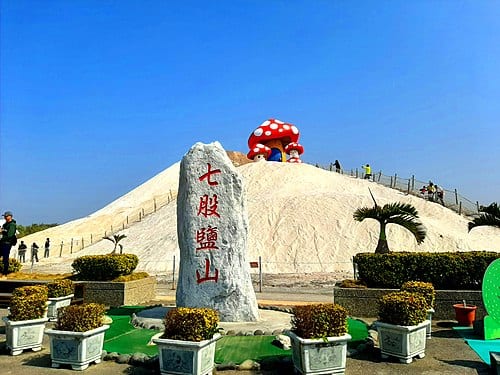
Qigu Salt Mountain is an artificial salt-pile landscape in Qigu District, Tainan, formed at the site of the former Qigu Salt Flat. Taiwan's salt industry officially ceased production in May 2002, ending 338 years of solar salt-making history, and the final batch of unprocessed salt was piled into this roughly 20-meter-high white mountain of about 60,000 tonnes of salt, now transformed into a tourist attraction.
Qigu Salt Flat was once Taiwan's largest solar salt production site; Taiwan's salt industry was officially discontinued in May 2002, ending 338 years of solar salt-making history on the island. The final stockpile of unprocessed salt was piled into the mountain's peak, reaching about 20 meters in height — roughly equivalent to a seven-story building — and holding an estimated 60,000 tonnes of salt. The adjacent Taiwan Salt Museum documents the full history of Taiwan's salt industry from the Dutch colonial period through its closure.
What to See at Qigu Salt Mountain
Qigu Salt Flat was historically Taiwan's largest solar salt production site. After Taiwan's salt industry formally ceased production in 2002, the vast accumulated stock of table salt could not all be processed, leaving a salt mountain about 20 meters high in Yancheng Village. Composed of hundreds of thousands of tonnes of salt crystals, the mountain is white in color; after rain, the surface shows a slight pattern of dissolved-and-recrystallized textures entirely different from ordinary natural terrain.
Next to the site stands the Taiwan Salt Museum, which provides a systematic presentation of Taiwan's solar salt history, the geographic distribution of salt fields, and the evolution of salt-making technology. The museum holds a comprehensive record of Qigu's salt fields, including salt industry development data from the Japanese colonial period through the post-retrocession era. You can walk to the top of the salt mountain, with wide views; on a clear day you can look out over the former salt field sites and the distant coastline.
How to Make the Most of Your Visit
Practical Information
Getting There & Timing
- Located in Yancheng Village, Qigu District, about 35 km from central Tainan; driving is recommended, as public transport options are limited.
- Both the salt mountain grounds and the Taiwan Salt Museum charge admission; check the official website to confirm ticket prices and opening hours.
- Summer afternoon temperatures are high and the salt mountain has no shade — avoid midday visits and bring sun protection.
Nearby Connections
- Qigu Black-Faced Spoonbill Reserve is about 5 km from the salt mountain — a natural pairing for the same day, forming a Qigu nature-and-industry day route.
- Qigu Fishing Harbor is about a 10-minute drive from the salt mountain — a good spot to try Qigu local seafood.
For ticket prices and opening hours, please consult the Taiwan Salt Museum's official website.
Frequently Asked Questions
When did Qigu Salt Flat cease production?
Taiwan's salt industry officially ceased production in May 2002, ending 338 years of solar salt-making history.
How tall is Qigu Salt Mountain and how much salt does it hold?
The peak stands about 20 meters tall — roughly a seven-story building — holding an estimated 60,000 tonnes of salt.
What else can visitors see next to the salt mountain?
The adjacent Taiwan Salt Museum documents the full history of Taiwan's salt industry from the Dutch colonial period to its closure.
Sources
- 七股鹽山 - 交通部觀光署 — 2002年5月停產、鹽業338年歷史、鹽山高度20公尺、堆鹽約六萬噸