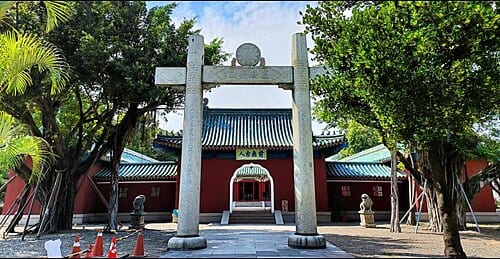
Koxinga Shrine is a state-built memorial temple to Zheng Chenggong (Koxinga), the only such shrine in Taiwan built under official Qing government direction. Its site is traditionally linked to the earlier Kaishan Wang Temple (said to date to 1662). In 1874, Shen Baozhen petitioned the Qing court to establish an official shrine, which was built in the Fuzhou architectural style in 1875 — not the "Ming style" sometimes claimed — before being fully rebuilt in 1963–64 under National Cheng Kung University professor Ho Chen Ts'u into its current reinforced-concrete northern Chinese palace-style form.
The Koxinga Shrine's predecessor, Kaishan Wang Temple, is traditionally said to date to 1662 during the Ming loyalist Zheng regime. In 1874, Shen Baozhen, in Taiwan for defense preparations following the Mudan Incident, petitioned for an official shrine; it was built in the Fuzhou architectural style, begun in March 1875 and completed in August 1875 — not the Ming style. From 1963 to 1964, National Cheng Kung University professor Ho Chen Ts'u oversaw a complete rebuild into a reinforced-concrete northern Chinese palace-style structure, which is why the shrine is not listed as a designated historic monument. Koxinga's birthday by the lunar calendar falls on the sixteenth day of the first month; the official spring rite is held around the end of April on the solar calendar, and the autumn rite on the fourteenth day of the seventh lunar month.
Highlights of Koxinga Shrine
The shrine follows a Ming architectural style that differs markedly from most Hokkien-style temples in Taiwan. The front walls are decorated with yellow glazed tile, and the courtyard exudes a quiet solemnity. The architectural form is an important case study in official Qing-dynasty temple construction. Old banyan trees stand in the plaza in front of the shrine, adding to the composed atmosphere. The shrine regularly holds ceremonies for Koxinga's birthday (the sixteenth day of the first lunar month), drawing both local worshippers and historians.
The Koxinga Artifact Museum within the compound displays historical materials, reproduction artifacts, and illustrated panels relating to Koxinga and the Kingdom of Tungning — covering the historical background of Zheng's recovery of Taiwan, his military strategy, and administrative system. It is a key reference point for understanding Tainan as the first Han Chinese political center in Taiwan. Though modest in scale, the museum is clearly organized and pairs well with Chihkan Tower to form a Ming-Tungning Taiwan history itinerary.
How to make the most of your visit
Practical information
Getting there and timing
- Located on Kaishan Road in Tainan's East District, about a 15-minute walk from Chihkan Tower. Tainan city buses and YouBike serve the area; nearby parking is limited.
- For current opening hours of the shrine and artifact museum, check official information from the Tainan City Cultural Affairs Bureau. Hours may be adjusted on certain holidays or during ceremonies.
- Combining the shrine with Chihkan Tower and the Confucius Temple into a half-day history and culture itinerary is recommended. The three sites together span a walking circuit of roughly 2–3 kilometers.
Nearby connections
- Within walking distance of the Tainan Confucius Temple cultural zone and Chihkan Tower, forming a walking route through the historical core of the old walled city.
- Kaishan Road in the East District has a scattering of heritage-house cafés and specialty shops where you can stop for Tainan-style food and drink after your visit.
Source: some details drawn from publicly available Wikipedia information.
Frequently Asked Questions
Was the 1875 rebuilding done in the Ming style?
No, it was built in the Fuzhou style; the "Ming style" description is inaccurate.
When was the current northern-palace-style building built?
It was completely rebuilt in 1963-64 under NCKU professor Ho Chen Ts'u.
Why isn't the shrine a designated historic monument?
Because the 1963 rebuild replaced the original architecture with a reinforced-concrete northern palace-style structure.
Sources
- 延平郡王祠-維基百科 — 1875年福州式改建、1963-64年全面改建、鄭成功祭典日期等沿革細節
- 延平郡王祠-臺南市政府文化局古蹟營運科 — 官方古蹟資訊頁面