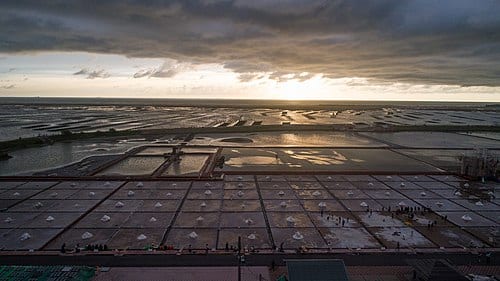
Jingzijiao Tile-Pan Salt Fields is a tourist salt field in Beimen District, Tainan, originally named Laidong Field, relocated to its current site in 1818 (the 23rd year of the Jiaqing reign) after flood damage and never moved since — making it Taiwan's longest-standing salt field at its present location. The tile-pan method of laying pottery shards on the salt field floor is said to trace back to salt-production reforms by Chen Yonghua during the Ming-Zheng era. Now operating as a tourist attraction, visitors are welcome to try manual salt harvesting, and the sunset reflected across the salt field water is especially spectacular, making this one of the most historically layered attractions in Beimen District.
Jingzijiao Tile-Pan Salt Fields, originally named Laidong Field, relocated several times due to flooding before finally settling at its current site in 1818 (the 23rd year of the Jiaqing reign), where it has remained for over 200 years without moving. The tile-pan method — laying pottery shards on the salt-field floor and letting sun evaporation crystallize the salt — is said to trace back to salt-production reforms by Ming-Zheng era advisor Chen Yonghua. Commercial salt production at the site ended in 2002, after 338 years of operation.
What to see at Jingzijiao Tile-Pan Salt Fields
The tile-pan salt field method involves laying broken pottery tiles on the salt field floor, using the heat absorbed by the tiles to evaporate seawater and crystallize salt. This technique originated along the southwest coast of Taiwan and has been documented since the Kangxi reign of the Qing dynasty. Jingzijiao Salt Fields are the most complete and historically oldest surviving tile-pan salt fields in Taiwan, holding significant meaning in the cultural history of Taiwan's salt industry. Compared to other salt fields that have been abandoned or redeveloped, this site is in relatively good condition.
The tourist salt field has a display area explaining the tile-pan salt production process and history, and visitors can try the manual scraping and collecting motions during designated time slots. At sunset, the sky's changing colors are reflected across the salt field water, and the flat, open surroundings with unobstructed views create a powerful interplay of light and shadow. Early morning mist brings a different, quieter atmosphere, though the sunset period is the most popular with photographers.
Tips for getting the most out of your visit
Practical information
Getting there and time needed
- Located in Yonglongli, Beimen District, Tainan. Driving or riding a scooter is the most convenient way to get there. The coastal area lacks public transport — bring your own.
- For opening hours and activity time slots, check with the Tainan City Government Department of Tourism or the on-site visitor center. Sunset times vary slightly by season.
Nearby connections
- Beimen Lagoon is right nearby. A combined visit on the same day is recommended for both the coastal ecology of Taijiang National Park and the salt industry culture.
- Nankunshen Daitian Temple is about a 10-minute drive from Yonglongli, Beimen, and can serve as a cultural afternoon extension.
Source: Wikipedia entry on Jingzijiao Salt Fields and Tainan City Government cultural tourism data.
Frequently Asked Questions
Was Jingzijiao Tile-Pan Salt Fields built during the Kangxi era of the Qing dynasty?
Not exactly — the tile-pan technique is said to trace back to reforms by Chen Yonghua during the Ming-Zheng era, but the current site was settled after a flood-driven relocation in 1818 (the Jiaqing era), where it has remained for over 200 years.
What is the tile-pan salt-making method?
Broken pottery tiles are laid on the salt field floor, seawater is channeled into the pool, and sun evaporation crystallizes the salt on the tiles.
Is commercial salt production still active at Jingzijiao today?
No, commercial salt harvesting ended in 2002; the site now operates as a tourist salt field where visitors can try manual salt harvesting.
Sources
- 井仔腳瓦盤鹽田 - 交通部觀光署 — 官方確認瀨東場1818年遷至現址、陳永華製鹽工法起源、2002年結束338年曬鹽業