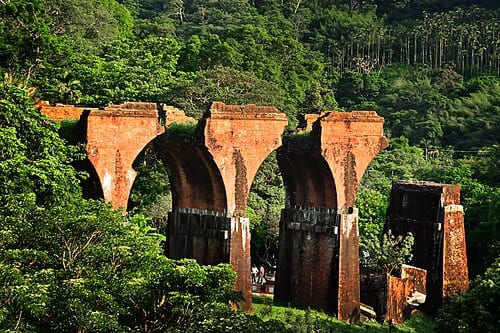
Longteng Broken Bridge is a Japanese-era red-brick railway bridge ruin in Sanyi Township, Miaoli County, its span shattered by the magnitude-7.1 1935 Hsinchu–Taichung earthquake and only its piers surviving today as a county historic site.
Originally named Yutengping Bridge, Longteng Broken Bridge broke ground on April 30, 1906, was completed on June 1, 1907, and opened to traffic on February 20, 1908. The full bridge measured 164.8 meters with 9 arch openings across 8 piers — six 9.14-meter semicircular arches, two 18.3-meter steel plate girder spans, and one 60.96-meter Baltimore truss span. The magnitude-7.1 Hsinchu–Taichung earthquake of April 21, 1935, whose epicenter lay near Guandao Mountain in nearby Sanyi, sheared through piers 4, 7, and 8; an aftershock on July 17 that same year collapsed the 9th arch. Rather than repair the original span, Japanese railway authorities built a replacement bridge 80 meters to the west, completed in 1938.
Highlights of Longteng Broken Bridge
The piers are built of red brick faced with imitation stonework, reflecting the mixed technical vocabulary of Japanese-era railway engineering. Completed in 1908 by the Railway Bureau of the Taiwan Governor-General's Office, the original bridge was about 118 meters long with 7 arch spans. After the 1935 Hsinchu–Taichung earthquake (magnitude 7.1), much of the span collapsed; the surviving piers are now scattered across a broad valley, forming a composition that is both powerful and desolate.
An observation deck with interpretation panels explains the bridge's structure and the sequence of the earthquake event. Viewed from a distance, the piers arranged among green hills make this one of the few places in Taiwan where the scale of an industrial ruin can be experienced in an open panorama. During the April tung blossom season, white flowers dot the hillsides, creating a vivid color contrast with the red-brick piers.
How to Make the Most of Your Visit
Practical Information
Getting There & Timing
- By car: Exit at Sanyi Interchange on National Freeway 1, head north on Provincial Highway 13 and follow signs toward Longteng Village — about 15 minutes. Free roadside parking is available but limited; arrive early on weekends.
- On foot: About 20 minutes walking from Shengxing Station, with signs along the way. Non-slip footwear is recommended.
- Open all day; no admission fee. On-site panels explain the historical background.
Nearby Connections
- Shengxing Station: walkable — recommended as a same-day stop.
- Sanyi Wood Carving Museum: about 15 minutes by car — good for adding an indoor cultural segment.
- County Road 49 corridor: mountain roads in the area suit cycling and exploring the hill-town character of Sanyi.
Source: Miaoli County Culture and Tourism Bureau; Railway Culture Association interpretation materials.
Frequently Asked Questions
How did Longteng Broken Bridge become 'broken'?
The red-brick railway bridge, opened in 1908, was shattered by the magnitude-7.1 1935 Hsinchu–Taichung earthquake, leaving only its piers standing — hence the name.
How long was the original bridge?
The original span measured 164.8 meters with 9 arch openings across 8 piers, a mixed brick-and-steel structure unusual for its time.
How did rail service continue after the earthquake?
Japanese authorities abandoned repair of the original bridge and built a replacement 80 meters to the west, completed in 1938, while the damaged original was left standing as a ruin.
Sources
- 魚藤坪斷橋 - 維基百科 — 橋梁規格164.8公尺、9孔8墩、施工日期
- 1935年新竹-台中地震 - 維基百科 — 地震規模7.1、震央位置