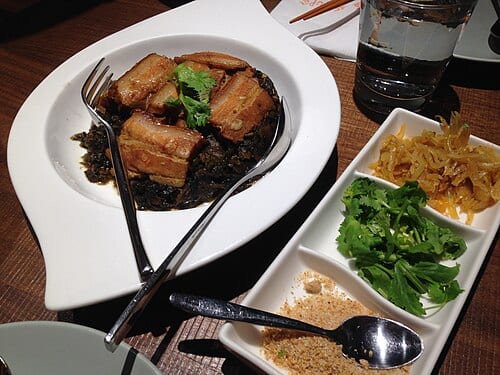
Mei gan kou rou is a Hakka banquet dish of pork belly braised with preserved mustard greens, the crowning course on a Miaoli Hakka table. Mustard greens grown in Guankuan Township are salted, sun-dried, and fermented into mei gan cai, then steamed for hours with pork belly until the fat is absorbed into the greens, leaving the meat rich but not greasy.
The Miaoli District Agricultural Research and Extension Station records that Guankuan Township farmers sow mustard greens each August, transplant seedlings after 25–30 days, and harvest from late October to November, processing the leaves by salting and sun-drying into suan cai, fu cai, and mei gan cai — a major local agricultural product. Nanzhuang's Lao Jinlong Restaurant, a representative Hakka banquet restaurant in Miaoli, was founded in 1963 (Republic of China year 52); its mei gan kou rou is one of the classic Hakka dishes on its menu alongside stir-fried pork with dried squid and pork intestine with ginger.
What is Braised Pork Belly with Preserved Mustard Greens
Mei gan cai is made by salting, sun-drying, and fermenting mustard greens (jie cai). Guankuan Township in Miaoli has extensive mustard green cultivation, and the mei gan cai produced there is known for its deep, rich savory aroma — recorded by the Miaoli District Agricultural Research and Extension Station as a representative local preserved product. The preparation of kou rou: pork belly is first partially cooked, then deep-fried until the skin is crisp, cut into thick slices with skin-side down in a bowl, covered with mei gan cai, and then steamed for two to three hours. When unmolded onto a plate, the salty-sour mei gan cai neutralizes the fattiness of the pork belly; after steaming, the umami of both ingredients melds and the sauce reduces to a thick, flavorful glaze — rich in taste without feeling oily.
Hakka banquet restaurants throughout Miaoli County offer this dish as a standard feature of traditional Hakka banquet menus. Established restaurants including Sanyi Shengxing Jixianglou, Guankuan Zaozhuang Ancient Garden Mansion, and Nanzhuang Lao Jinlong Restaurant (about fifty years of history) are all known for this dish. Shihnang Wanjia's Miaoli Hakka Food Map and Lighttour's "Most Authentic Hakka Food Recommendations" both explicitly include it. Another common way to eat it is to tuck a slice of kou rou with mei gan cai into a gua bao (steamed bun) — the pickled aroma of the mei gan cai plays beautifully against the soft, pillowy bun skin, a variation popular among younger diners.
How to eat it authentically
Local knowledge
Verified sources
- The Miaoli District Agricultural Research and Extension Station explicitly records mei gan cai (Guankuan mustard green preserved product) as a representative local preserved agricultural specialty of Miaoli.
- Shihnang Wanjia's Miaoli Hakka Food Map and Lighttour's '9 Most Authentic Hakka Food Recommendations' both list braised pork belly with preserved mustard greens as a representative Miaoli Hakka dish.
- Nanzhuang Lao Jinlong Restaurant (about fifty years of history) and Guankuan Zaozhuang Ancient Garden Mansion are long-established banquet restaurants in Miaoli County with tenure-backed reputations.
Visitor tips
- This dish requires long steaming time; some restaurants need a day's advance reservation. Walk-in orders may be served a pre-made version, which is slightly inferior in flavor — calling ahead to order is recommended.
- Guankuan mei gan cai differs markedly from machine-brined products from other counties. When buying packaged mei gan cai as a gift, confirm the label states "Guankuan" or "Miaoli" as the place of origin.
- Hakka banquet restaurants are mostly family-run; Monday closures are common, and reservations are needed on busy holidays. Service often stops accepting new tables after 3 p.m.
Sources: Miaoli District Agricultural Research and Extension Station mei gan cai agricultural specialty records; Shihnang Wanjia Miaoli Hakka Food Map; Lighttour Hakka food recommendations feature.
Frequently Asked Questions
What is the preserved mustard green (mei gan cai) in this dish made from?
It is mustard greens grown in Guankuan Township, salted, sun-dried, and fermented; the Miaoli District Agricultural Research and Extension Station records the harvest and processing period as late October to November.
Does mei gan kou rou always use pork belly?
The traditional version uses skin-on pork belly, whose collagen and fat are absorbed by the mei gan cai for the deepest flavor; some restaurants substitute leaner pork shoulder for a lighter version.
Where in Miaoli can I find a long-established restaurant serving it?
Nanzhuang's Lao Jinlong Restaurant, founded in 1963, is a representative old Hakka banquet restaurant in Miaoli with mei gan kou rou as one of its signature dishes.
How else is mei gan kou rou served?
A popular variation tucks a slice into a gua bao (steamed bun), where the pickled aroma of the mei gan cai plays against the soft bun — a combination favored by younger diners.
Sources
- 芥菜好福菜香農業文化源流長-苗栗區農業改良場 — 公館芥菜/梅干菜製程官方記載
- 南庄老金龍飯店創立於民國五十二年 — 南庄老金龍飯店1963年創立及招牌客家菜紀錄