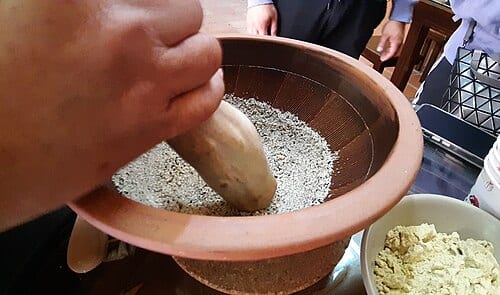
Hakka lei cha is a traditional drink made by grinding thirty to forty varieties of grains and seeds together with green tea, the oldest form of Hakka hospitality. Teahouses such as Yuetai Tea Cabin in Sanyi's Shengxing Village carry on the tradition, inviting visitors to pick up the pestle and grind it themselves, understanding through physical effort the Hakka philosophy of thrift and wholesome eating.
Yuetai Tea Cabin near Shengxing Station in Sanyi (tel. 03-787-3303) offers a hands-on Hakka lei cha DIY experience, grinding green tea with thirty to forty varieties of grains, and serves the drink in sweet, savory, and spicy versions, plus a summer slush variant. It is open 11 a.m.–7 p.m. on weekdays and 10 a.m.–8 p.m. on weekends, closed Thursdays.
What is Hakka Lei Cha
Lei cha (Hakka: lui cha) recipes vary by family; common ingredients include roasted rice, peanuts, sesame, pumpkin seeds, sunflower seeds, brown rice, red beans, Job's tears, pine nuts, and green tea leaves. After grinding to a fine powder, boiling water is added and the mixture is stirred into a pale-green, thick drink. The texture is between congee and tea — the aroma is complex and full-bodied. Sweet, savory, and spicy versions all have their followers: the sweet version adds sugar, the spicy version adds chili powder, while the traditional version is seasoned only with salt, giving a pure salty-savory flavor. A summer iced slush version is also available in warmer months.
Shengxing Village in Sanyi Township is the most concentrated area for lei cha experiences in Miaoli County. Yuetai Tea Cabin (No. 58, Shengxing, Shengxing Village), Shiliufen Cultural Teahouse, and Caiyuanju all offer self-grinding lei cha experiences and table service. The Hakka Township Travel official website and the Miaoli County Tourism Bureau both recommend and list these venues; multiple WalkerLand and Pixnet food reviews confirm that several legitimate lei cha experience venues exist within Sanyi Township in Miaoli County. The experience takes about fifteen to twenty minutes including the grinding and brewing steps; once finished, the lei cha can be enjoyed as an afternoon drink.
How to eat it authentically
Local knowledge
Verified sources
- The Hakka Township Travel official website and the Miaoli County Tourism Bureau both list the lei cha experience in Sanyi's Shengxing Village as a recommended Hakka village itinerary.
- Multiple WalkerLand and Pixnet food reviews confirm that Yuetai Tea Cabin (No. 58, Shengxing Village) and Shiliufen Cultural Teahouse are located within Sanyi Township, Miaoli County.
- Lei cha is recognized by the Council for Hakka Affairs as one of the representative food and drink cultures of Hakka villages in Taiwan, with government promotion records and cultural heritage significance.
Visitor tips
- Shengxing Old Street is crowded on weekends; teahouse experience slots are limited. Weekday visits or advance phone reservations are recommended to avoid long waits.
- Some tourist teahouses use pre-mixed lei cha powder and call it an "experience." A genuine self-grinding experience must include the full mortar-grinding step — confirm this before entering.
- Self-grinding requires sustained effort; continuous grinding for about fifteen minutes will fatigue the shoulders and wrists. Older visitors may ask staff for help with the second half of the grinding.
Sources: Hakka Township Travel official website; Miaoli County Tourism Bureau recommendations; multiple WalkerLand and Pixnet food review records.
Frequently Asked Questions
What ingredients go into Hakka lei cha?
Common ones include roasted rice, peanuts, sesame, pumpkin seeds, and green tea leaves — thirty to forty varieties in total, with recipes varying by family.
Is Hakka lei cha sweet or savory?
Both exist; the traditional version is salted and savory, while the sweet version was adapted for tourists, and some teahouses also offer a spicy version.
Where in Sanyi can I try the DIY experience?
Yuetai Tea Cabin near Shengxing Station offers the full grinding-and-brewing experience, open 11 a.m.–7 p.m. weekdays and 10 a.m.–8 p.m. weekends, closed Thursdays.
How long does the experience take?
The full grinding and brewing process takes about fifteen to twenty minutes and is physically tiring; older visitors can ask staff to help with the second half.
Sources
- 月台茶棧擂茶DIY體驗介紹 — 營業時間、電話、擂茶三味吃法
- 月台茶棧食記 — 擂茶研磨體驗流程紀錄