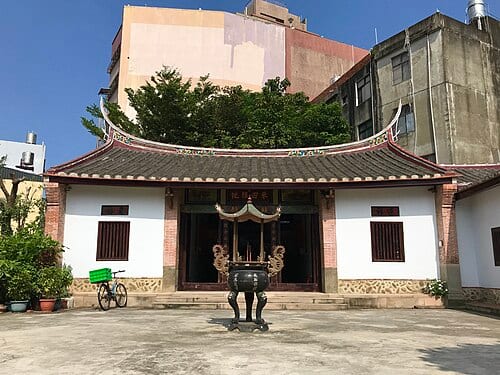
Caitian Fudi is a Qing-dynasty Taokas ancestral shrine in Zhubei City, Hsinchu County, founded in 1760 under the name 'Zhuzhan Tribe Seven-Surname Sinicized Public Hall' and renamed after an 1878 rebuild — now a county historic site and one of Taiwan's best-preserved Plains Indigenous public shrines.
Caitian Fudi was founded in 1760 under the original name 'Zhuzhan Tribe Seven-Surname Sinicized Public Hall.' A 1749 flood on the Toucian River had forced the Taokas Zhuzhan tribe to relocate to Xinshe in Zhubei, and in 1758 Taiwan Prefect Gioro Siming granted them the seven Han surnames Jin, Pan, Liao, Wei, San, Li, and Qian. The main ancestral ceremony is held every year on the 17th day of the 7th lunar month, when descendants of the seven surnames return to worship. The site was designated a Hsinchu County historic site in 2006, with restoration completed in 2008.
What to see at Caitian Fudi
Caitian Fudi is located in Xinshe Li, Zhubei City. During the Qing dynasty, Han settlers called the local Taokas people the 'Zhuzhan Tribe,' and this building served as the tribe's public shrine (place of communal worship). Having undergone several restorations, the main structure still retains its Qing-era sanheyuan (three-sided courtyard) layout. The shrine houses the Ali Zu (ancestral spirit tablet), the core of Taokas belief. The settlement around the building has become highly urbanized, making the historic site all the more precious.
The ancestral ceremony on the 15th day of the 9th lunar month is conducted by tribal descendants and preserves traditional ritual forms — a precious living cultural heritage of Plains Indigenous belief in Taiwan. Anyone wishing to observe or document the ceremony should first consult tribal members and respect their cultural sovereignty. On ordinary days, visitors can view the building's exterior and interior furnishings, and read the interpretive signs to learn about the Taokas people's history on the Hsinchu Plain.
Tips for making the most of your visit
Practical information
Getting there and timing
- By car from downtown Zhubei City toward Xinshe Li — about 10–15 minutes. Roadside parking is the main option nearby.
- Caitian Fudi is a county-designated historic site. The exterior can be viewed on regular days; interior access hours are irregular — call ahead to confirm before visiting.
Nearby connections
- Zhubei City has several Hakka cultural halls and old street settlements suitable for a half-day local cultural walk.
- Head to downtown Hsinchu to connect with City God Temple, Beimen Old Street, and other sights for a Hsinchu County–City cultural route.
Source: Text compiled from the Wikipedia article on Caitian Fudi and publicly available cultural heritage information. Please refer to the managing tribal community's latest announcements for opening times and ceremony dates.
Frequently Asked Questions
What is Caitian Fudi?
Caitian Fudi is a public worship shrine of the Taokas Zhuzhan tribe, founded in 1760 — one of the best-preserved Plains Indigenous shrines remaining in Taiwan.
Where does the name Caitian Fudi come from?
During an 1878 rebuild, the character for 'aborigine' in the old name was split into 'cai' and 'tian,' combined with the Han term 'Fudi' used for earth-god shrines, giving the site its current name.
When is the ancestral ceremony held?
The main ceremony takes place every year on the 17th day of the 7th lunar month, when descendants of the seven surnames return to worship their ancestors.
Sources
- 采田福地 - 維基百科 — 創建年代、竹塹社遷移史、賜姓過程
- 采田福地:道卡斯族竹塹社團結的力量 - 客新聞 HakkaNews — 祭祖儀式日期(農曆7月17日)