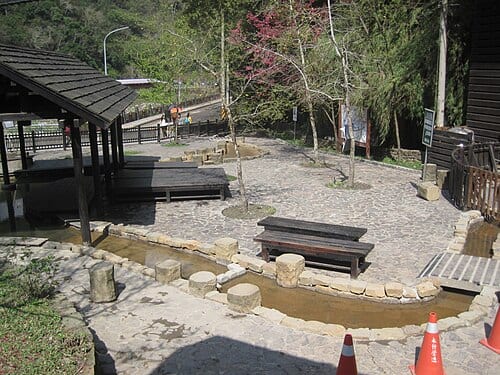
Qingquan Hot Spring is a hot-spring area beside the Shangping River in Wufeng Township, Hsinchu County, developed by Japanese police in 1913 under the name Inoue Hot Spring; its neutral sodium bicarbonate water runs about 43–48°C, making it one of Hsinchu County's oldest hot springs.
Qingquan Hot Spring was developed in 1913 by Japanese police as a bathhouse for officers guarding the frontier defense line, originally named Inoue Hot Spring; the Inoue Hot Spring Police Bathhouse was established in 1921. The water is a neutral sodium bicarbonate spring at about 43–48°C with a pH of roughly 6.6–6.7, and the site was once ranked among the 'Eight Scenic Sites of Hsinchu.'
What to see at Qingquan Hot Spring
Qingquan Hot Spring sits at about 700 meters above sea level, deep within the Shangping River gorge in Wufeng Township, surrounded by steep cliffs and dense vegetation. The sodium bicarbonate spring is colorless and odorless; soaking leaves the skin feeling smooth — hence its nickname 'beauty spring.' Water temperature ranges from about 40–50°C depending on the facility. The spring was developed as a public bathhouse during the Japanese colonial era, and several hot-spring facilities continue to operate today.
The gorge suspension bridge is an iconic Qingquan landmark. From the bridge you can look down at the river and the cliff faces on either side; it is also the route to the Zhang Xueliang Cultural Park former residence. The surrounding Atayal settlements preserve traditional weaving, totems, and seasonal ceremonies. When visiting, respect the community's way of life and cultural etiquette, and do not photograph without permission.
Tips for making the most of your visit
Practical information
Getting there and timing
- Qingquan is in a mountain area. By car from Zhudong, follow Provincial Highway 122 toward Wufeng Township — about 50 minutes. The mountain road is winding and narrow; drive with care, especially in larger vehicles.
- Public transport is infrequent; driving is recommended. Opening hours for each hot-spring facility vary; call or check online before you go.
Nearby connections
- Combine with Zhang Xueliang Cultural Park — the two are about 10 minutes apart on foot. A cultural tour followed by a hot spring soak makes for a well-rounded visit.
- Further exploration of other settlements or valley scenery in Wufeng Township is possible; confirm road conditions before heading out.
Source: Text compiled from the Wikipedia article on Qingquan Hot Spring and publicly available tourism information. Please refer to each operator's latest announcements for hot-spring facility hours and fees.
Frequently Asked Questions
When was Qingquan Hot Spring developed?
It was developed in 1913 by Japanese police as a bathhouse for officers guarding the frontier defense line, originally named Inoue Hot Spring.
What are the water quality and temperature of Qingquan Hot Spring?
It's a neutral sodium bicarbonate spring at about 43–48°C with a pH of roughly 6.6–6.7, leaving skin feeling smooth after soaking.
Where does the name 'Inoue Hot Spring' come from?
It's the Japanese-era name for Qingquan Hot Spring; the Inoue Hot Spring Police Bathhouse was established here in 1921.
What nearby sites can be combined with a visit to Qingquan Hot Spring?
The former residence at Zhang Xueliang Cultural Park is about a 10-minute walk away, good for a cultural visit before soaking.
Sources
- 清泉溫泉|維基百科 — 泉質、水溫、開發年份等條目資料