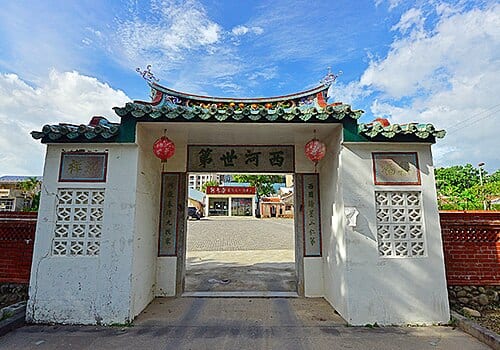
Xinwawu Hakka Culture Preservation Area is a preserved Hakka settlement in Zhubei City, Hsinchu County. Its core building, the Lin family's Zhongxiao Tang farmstead hall, was built in the 10th year of the Jiaqing reign (1805) and got its name, Xinwawu or New Tile House, because its roof tiles were newer than those of the neighboring Liuzhangli farmstead. In 2005 it became Taiwan's first designated Hakka culture preservation area. The site regularly hosts Hakka flower drum performances and other events, and the surrounding farmland preserves the look of early Zhubei's agricultural landscape.
Lin Sun-tan crossed from Raoping County, Chaozhou Prefecture, Guangdong, to Taiwan in the 23rd year of the Qianlong reign (1758); his sons Lin Xiang-xian and Lin Xiang-ming built the Zhongxiao Tang ancestral hall at Mangtoupu in the 10th year of Jiaqing (1805). Because its roof tiles were newer than the hall his cousin Lin Xiangun had built at Liuzhangli, it became known as Xinwawu, or New Tile House. In 1947 local residents formed a flower drum troupe that grew into a well-known Hsinchu performance group. The settlement faced demolition in 1990 due to land expropriation for the HSR Hsinchu Station special zone, but was preserved after advocacy from local historians and coordination between the Hakka Affairs Council and Hsinchu County Government; it was established as Taiwan's first Hakka culture preservation area in 2005.
What to see at Xinwawu Hakka Culture Preservation Area
The farmstead (a courtyard-style Hakka communal residence) is the core of Hakka living culture. The Lin family farmstead at Xinwawu retains the basic layout of a central hall flanked by protective wings, with walls of red brick and river stones. The door lintels and hall spaces still allow the traditional layout to be read clearly. The threshing ground now serves as an outdoor performance space — lively during large events, quiet on ordinary days.
The area hosts irregular Hakka flower drum performances, hands-on craft workshops, and market events. Event schedules are announced on the official website. The surrounding farmland is an open landscape; in certain seasons you can see paddy rice growing, and the reflections of the fields at dusk make it a favorite spot for families and photography visitors.
Tips for getting the most out of your visit
Practical information
Getting there and timing
- By car: Shuitian Li in Zhubei City is near Provincial Highway 68. Navigate by GPS; parking is available on-site.
- Opening hours and performance schedules are set by the Hsinchu County Cultural Affairs Bureau or Xinwawu's official information. Special holiday events are announced separately.
Nearby connections
- Several Hsinchu County cultural facilities are in Zhubei City; the County Cultural Center can be visited on the same trip.
- HSR Hsinchu Station (Liujia) is about a 10-minute drive from Xinwawu — convenient for out-of-town visitors connecting to the high-speed rail.
Sources: The Wikipedia entry for Xinwawu Hakka Culture Preservation Area and Hsinchu County Government Cultural Affairs Bureau records.
Frequently Asked Questions
Where does the name 'Xinwawu' come from?
The farmstead hall built by Lin Xiang-xian and Lin Xiang-ming in 1805 had newer roof tiles than the hall their cousin Lin Xiangun built at Liuzhangli, so it became known as Xinwawu, or New Tile House.
When was the Xinwawu Hakka Culture Preservation Area established?
It was established in 2005 as Taiwan's first Hakka culture preservation area.
Why did Xinwawu once face demolition?
In 1990 it was expropriated as state land within the HSR Hsinchu Station special zone; it was preserved only after local historians and the Hakka Affairs Council coordinated with the Hsinchu County Government.
What is the connection between the Hakka flower drum tradition and Xinwawu?
Local residents formed a flower drum troupe in 1947 that grew into a well-known Hsinchu performance group and became an important force in promoting Xinwawu's culture.
Sources
- 新瓦屋客家文化保存區 — 維基百科條目,含開墾與保存沿革