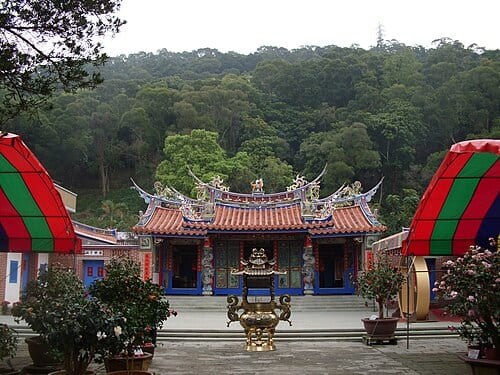
Shetou Qingshui Rock Temple is a Guanyin temple on the western slopes of the Bagua Mountain range in Shetou Township, Changhua County, founded in 1728 during the Yongzheng reign as a simple thatched shrine converted from a work shed. It was expanded repeatedly during the Qianlong reign and settled at its present site during the Jiaqing reign. Together with Hushan Rock and Bishan Rock temples, it is counted among central Taiwan's three great rock temples, and it is also one of central Taiwan's "Three Rock Temples and Two Temples." A trail and viewpoint behind the temple overlook the farmland of Shetou and Yuanlin, combining religious devotion with the character of a natural hillside setting.
Shetou Qingshui Rock Temple was founded in 1728 during the Yongzheng reign as a simple thatched shrine converted from a work shed. It was rebuilt as a bamboo temple in 1745 through fundraising among worshippers, then reconstructed by the monk Juetong of Quanzhou together with local gentry in 1758, before settling at its present location during the Jiaqing reign. The temple enshrines Shakyamuni Buddha, Guanyin Bodhisattva, Amitabha Buddha, and the Medicine Buddha, making it one of the earliest temples in Taiwan to worship the "Three Treasure Buddhas" together; it was formerly known by the poetic name "Spring Light at Qingshui," one of the Eight Scenic Views of Changhua.
What to see at Shetou Qingshui Rock Temple
The temple site was selected in front of a cliff on the western slopes of the Bagua Mountain range, with the rear of the temple built directly against the rock face. The architecture is arranged in tiers to follow the natural topography, creating the distinctive spatial character of Taiwan's traditional mountain temples. The temple has stood for more than two hundred years and has undergone multiple repairs. The existing structure blends the Qing-dynasty layout with more recent restorations. The forecourt plaza is an important gathering place for local worshippers.
A trail system runs through the hills behind the temple. Following stone steps up from the rear of the temple leads to a viewpoint overlooking the agricultural plains of Shetou and Yuanlin. The vegetation along the trail is mostly mixed woodland; mountain breezes keep things cool, and the route is suitable for light hiking. The 19th day of the 2nd lunar month each year — Guanyin Bodhisattva's birthday — is an important temple ceremony, with traditional rituals and local troupe performances.
How to make the most of your visit
Practical information
Getting there & timing
- Shetou Township has no train station. Driving is recommended: head south from Yuanlin City along Provincial Highway 1 to Shetou, then follow the signs. There is a parking area in front of the temple.
- The temple is open year-round; daytime visits are recommended. The rear hill trail may be muddy after rainy season — exercise caution.
Nearby connections
- Yuanlin Baiguo Mountain is about 15 minutes away by car. A combined route through Yuanlin and Shetou linking natural scenery with a temple visit is easy to arrange.
- Shetou Township is known for functional cotton textiles (towels and blankets). Stopping to learn about the local textile industry and culture is an option.
Source: Changhua County Government, literature on the Three Yan Two Si in the Taiwan Temple Gazetteer.
Frequently Asked Questions
When was Shetou Qingshui Rock Temple founded?
It was founded in 1728 during the Yongzheng reign, originally as a thatched shrine converted from a work shed.
What major expansions did the temple undergo?
It was rebuilt as a bamboo temple in 1745, reconstructed by the monk Juetong in 1758, and settled at its present site during the Jiaqing reign.
Which deities does the temple enshrine?
It is dedicated primarily to Guanyin Bodhisattva, alongside Shakyamuni, Amitabha, and the Medicine Buddha, making it one of Taiwan's earliest temples to worship the Three Treasure Buddhas together.
Sources
- 社頭清水岩-臺灣宗教文化地圖 — 內政部宗教文化地圖,載明1728年雍正6年創建、後續擴建年代
- 社頭清水岩-維基百科 — 交叉核對創建與遷址歷史