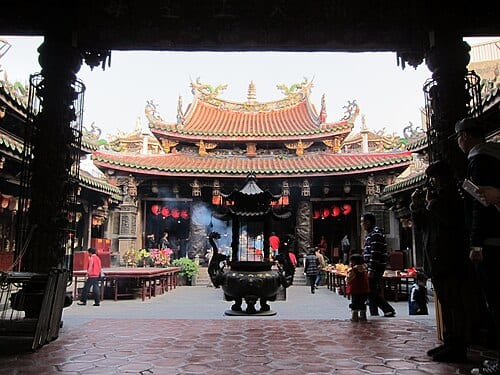
Lukang Mazu Temple is a temple in Lukang Township, Changhua County, enshrining a founding Mazu statue said to have been carried from the Meizhou ancestral temple to Taiwan in 1683 during Shi Lang's military campaign; relocated to its present site in 1725 after Shi Shibang donated the land, it was upgraded to National Historic Site status in 2019 and is Taiwan's only Mazu temple to hold this ancestral-temple statue.
According to tradition, Lukang Mazu Temple began in 1591 as a small 'Tianfei Temple' built by local residents to pray for the safety of merchant ships; in 1683, Lan Li, an aide to Admiral Shi Lang during his campaign to bring Taiwan under Qing rule, is said to have carried the founding Mazu statue from the Meizhou ancestral temple across the strait, and Shi Lang's grandnephew Shi Shibang later petitioned to keep the statue enshrined in Lukang. In 1725, Shi Shibang donated land for the temple to be relocated to its current site. Changhua County's Cultural Affairs Bureau nominated the temple for upgrade in November 2017; after nearly two years of review, it was elevated from a county-designated historic site to a National Historic Site in 2019 — the 7th in Changhua County and the 106th nationwide.
Highlights of Lukang Mazu Temple
Tianhou Temple ranks alongside Longshan Temple and Wenshi Temple as one of Lukang's three major historic sites, and was the spiritual heart of central Taiwan's maritime trade during its Qing dynasty heyday. In the Qing period, Lukang's port was prosperous, and merchant vessels would stop to worship at Tianhou Temple before putting out to sea, building its considerable religious prestige. The temple's architectural layout has been restored in successive eras, yet some original Qing dynasty elements survive; the stone and wood carvings continue the Minnan craft tradition, and the swallowtail ridge of the Shanchuan Hall is clearly defined.
The forecourt plaza is an important public gathering space for Lukang. The temple regularly holds folk activities such as the Mazu procession and Beiguan music performances. Visitors can experience the grandest ceremonial atmosphere around the 23rd day of the third lunar month — Mazu's birthday. Along Zhongshan Road, traditional confectionery shops have survived, selling Lukang specialties such as phoenix-eye cake (fengyangao) and ox-tongue pastry (niushebing), adding a sense of everyday life to a temple visit.
Tips for Getting the Most Out of Your Visit
Practical Information
Getting There & Visiting Hours
- Take Changhua Bus from Changhua Train Station to Lukang — about 30 minutes. From the bus stop, the temple on Zhongshan Road is about a 5-minute walk.
- The temple is open to visitors year-round at no charge. It becomes crowded during certain festivals; weekdays are recommended.
Nearby Connections
- The Yaolin Street and Putou Street Old Street area is within walking distance; continue east to reach Longshan Temple, forming a complete Lukang cultural route.
- The Lukang Folk Arts Museum is on the northern stretch of Zhongshan Road and can be visited the same day for a deeper look at everyday life in Qing dynasty Lukang.
Sources: Cultural Heritage Bureau, Ministry of Culture; official information from Lukang Mazu Temple.
Frequently Asked Questions
Where did the Meizhou founding Mazu statue in Lukang Mazu Temple come from?
Tradition holds that in 1683, Lan Li, an aide to Admiral Shi Lang, carried the founding Mazu statue from the Meizhou ancestral temple to Taiwan, and Shi Shibang later petitioned to keep it enshrined in Lukang.
When was Lukang Mazu Temple relocated to its current site?
In 1725, Shi Shibang donated the land for the temple to be relocated to its present site in Lukang.
When was Lukang Mazu Temple upgraded to National Historic Site status?
It was elevated from a county-designated historic site to a National Historic Site in 2019 — the 7th in Changhua County and the 106th nationwide.
Sources
- 鹿港天后宮 - 維基百科 — 創建、遷建年份,湄洲開基神像來源
- 具400多年歷史 鹿港天后宮升格國定古蹟 - 公視新聞網 — 2019年升格國定古蹟、全國第106處