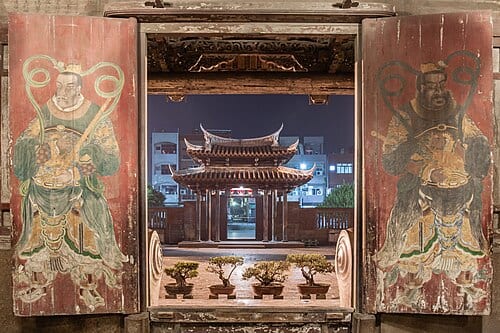
Lukang Longshan Temple is a Qing-dynasty temple in Lukang Township, Changhua County, rebuilt at its present site in 1786 and designated a National Historic Site in 1983; the full three-courtyard, two-yard, seven-bay layout survives intact, and the octagonal caisson ceiling above its opera stage — built entirely from interlocking bracket sets — is the oldest surviving example of its kind in Taiwan.
According to tradition, Longshan Temple traces its origin to 1647, when Quanzhou settlers brought incense from Quan'an Longshan Temple to found a small shrine; in 1685 the monk Chunzhen built the temple's direct predecessor, and in 1786 (the 51st year of the Qianlong reign) administrators Lin Zhensong and Chen Bangguang relocated it to its present site on today's Jinmen Street. The complex covers roughly 1,600-plus ping and was designated a first-grade historic site (now a National Historic Site) on 28 December 1983. The octagonal caisson ceiling above the opera stage was built during the 1831 (Daoguang 11) renovation — spanning about 5.5 meters with a height of roughly 6.5 meters to its center, assembled from 16 sets of interlocking brackets — and is the oldest and largest surviving example of its kind in Taiwan.
Highlights of Lukang Longshan Temple
The temple's origins trace back to the late Ming and early Qing dynasties; after several rounds of reconstruction, the current layout was fixed during the Qing period. The complex runs in sequence from the main gate through the Five-Gate Hall, the main hall, and the rear hall — three courtyards deep, with east and west corridors in perfect symmetry. The temple is ornamented extensively with Quanzhou white granite and blueschist stone, carved with motifs of flowers, birds, figures, and mythological scenes. The style is refined and precise, and the temple is considered a benchmark of Minnan-style traditional temple architecture in Taiwan.
The octagonal caisson ceiling of the main hall is the temple's most celebrated structural feature: bracket sets layer outward to create a spiraling vortex pattern that, when viewed from below, resembles a geometric labyrinth. Each year on the 19th day of the second lunar month — the birthday of Guanyin Bodhisattva — traditional ceremonies are held, with incense smoke filling the air and worshippers crowding the halls, offering a close-up experience of traditional religious life in Lukang. The temple forecourt often hosts folk-artifact displays, and interpretive panels assist visitors.
Tips for Getting the Most Out of Your Visit
Practical Information
Getting There & Visiting Hours
- Take Changhua Bus or Yuanlin Bus to Lukang Main Station, then walk or rent a bicycle — roughly 20 minutes by bus.
- Open year-round. Visiting between 9 a.m. and 4 p.m. is recommended to ensure enough light for viewing the caisson ceiling; check the official announcement for detailed hours.
- Photography of deity statues at close range is not permitted inside the temple. Please dress neatly and maintain a quiet atmosphere.
Nearby Connections
- Lukang Mazu Temple is a 15-minute walk away; heading east from there you can reach the Yaolin Street and Putou Street Old Street area.
- The Lukang Folk Arts Museum is nearby, housing everyday objects from the Qing dynasty that complement the architectural and cultural themes of Longshan Temple.
Sources: Cultural Heritage Bureau, Ministry of Culture (historic site database); Lukang Township Office.
Frequently Asked Questions
When was Lukang Longshan Temple relocated to its current site?
It was rebuilt at its present site in 1786 under the direction of administrators Lin Zhensong and Chen Bangguang, and was designated a National Historic Site in 1983.
What is the temple's architectural layout?
The complex follows a three-courtyard, two-yard, seven-bay layout, running in sequence from the main gate through the Five-Gate Hall, opera stage, worship hall, main hall, and rear hall.
Where is the octagonal caisson ceiling located?
It sits above the opera stage, built during the 1831 renovation from 16 sets of interlocking brackets, and is the oldest surviving example of its kind in Taiwan.
Sources
- 鹿港龍山寺 - 維基百科 — 創建、遷建、國定古蹟年份,三進二院七開間格局
- 鹿港龍山寺官網-戲台 — 八卦藻井位置與尺寸數據