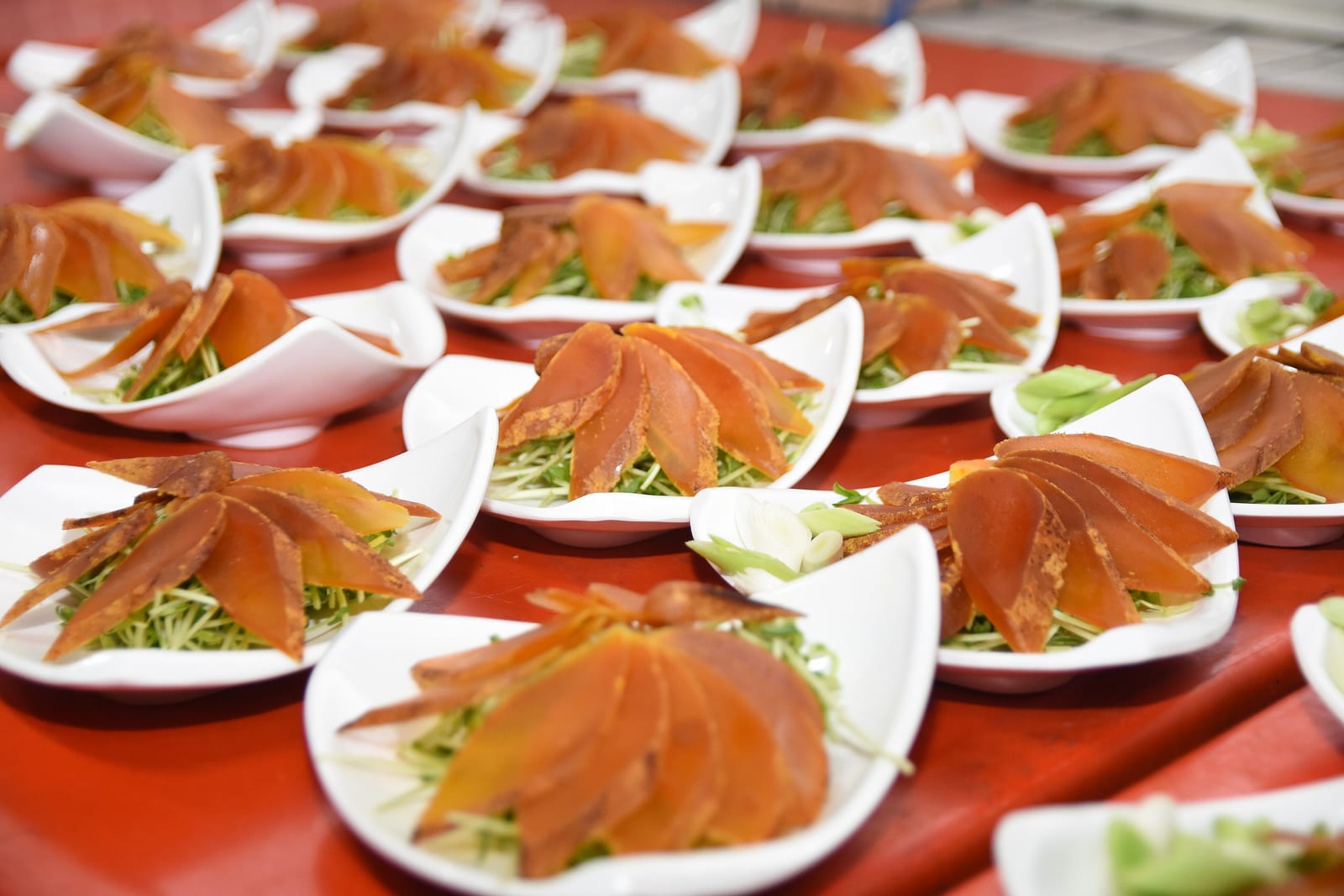
Kouhu Mullet Roe is a traditional preserved seafood made by salting and sun-drying the roe of grey mullet farmed along Yunlin's Kouhu coast, a region that supplies roughly 60% of Taiwan's national mullet output and sits within the only country in the world that farms grey mullet specifically for roe production. Around the winter solstice, drying racks along the fish ponds in Chenlong and Jinhu hang with amber slabs of roe glowing in the sun; sliced thin and paired with garlic shoots and white radish, it's one of the most festively flavored seafoods on the Taiwanese table.
Taiwan is the only place in the world that farms grey mullet specifically for roe production, and Kouhu Township is the country's leading mullet-producing region, supplying roughly 60% of national output; the Yunlin County Government holds an annual "Kouhu Mullet Cultural Festival" at the square in front of Kouhu Township Farmers' Association, spotlighting the peak season around the winter solstice (November through January).
What is Kouhu Mullet Roe
Mullet roe (wuyu zi) is made from the ovary sac of grey mullet, removed whole, then salt-cured, pressed flat, sun-dried, and shade-dried over several weeks into a traditional preserved seafood product. Fresh ovary sacs are thick and plump; after salting to draw out moisture and fix the shape, they're flipped repeatedly under the sun and eventually form two flat, golden-amber, semi-translucent slabs of "black gold." Kouhu mullet roe features complete, intact lobes, an orange-red color, and rich oil content — a benchmark for premium Taiwanese seafood. The standard preparation is to sear or roast until warm, then slice thin and serve with garlic shoots, white radish, and green apple; the salty, savory finish with a lingering sweetness is the essence of mullet roe.
Kouhu's status as a mullet roe destination is inseparable from Yunlin's aquaculture heritage. Taiwan is the only place in the world that deliberately farms grey mullet specifically for roe production; the coastal communities of Chenlong, Jinhu, Taizi, and Xialun in Kouhu Township are the core farming zone. The Yunlin County Government holds an annual "Kouhu Mullet Cultural Festival" and the Ministry of Agriculture's food education platform lists Kouhu as a representative mullet production area. Local farming expertise is mature — from pond raising and extraction to drying, the entire process is controlled — and the quality gap with wild-caught roe has narrowed substantially, while supply is far more consistent.
How to eat Kouhu Mullet Roe the authentic way
Local knowledge
Objective endorsements (sponsored content filtered out)
- The Yunlin County Government holds an annual "Kouhu Mullet Cultural Festival"; the Ministry of Agriculture's food education platform lists Kouhu as a representative mullet production area
- Taiwan is the only place in the world that farms grey mullet specifically for roe production; Kouhu is the core aquaculture zone
- The coastal communities of Chenlong, Jinhu, Taizi, and Xialun in Kouhu Township form the mullet farming heartland — a category-cluster-level landmark
Visitor tips
- Mullet roe peak season is around the winter solstice (November to January); visit during this window for the freshest current-season product
- When buying in person, look for vacuum packaging, clear origin labeling, and fishermen's association endorsement; avoid unmarked bulk product of uncertain provenance
- Combine with Chenlong Wetland, Kouhu Visitor Center, and Jinhu Wanshan Temple for a half-day ecotourism and fishing village culture trip
Data compiled from the Yunlin County Government Department of Culture and Tourism, township-level farmers' associations, and large volumes of public reviews; sponsored content has been filtered out.
Frequently Asked Questions
What's unique about Taiwan's grey mullet farming?
Taiwan is the only place in the world that farms grey mullet specifically for roe production, unlike other countries where mullet is farmed mainly for its meat.
What role does Kouhu play in Taiwan's mullet roe industry?
Kouhu Township is the country's leading mullet-producing region, supplying roughly 60% of national output, making it the core production area for Taiwanese mullet roe.
When is the Kouhu Mullet Cultural Festival held?
The Yunlin County Government holds the "Kouhu Mullet Cultural Festival" annually at the square in front of Kouhu Township Farmers' Association, timed around the peak roe season near the winter solstice.
When is mullet roe freshest and in peak season?
Peak season falls around the winter solstice, roughly November through the following January, when the roe available is freshest and fullest.
Sources
- 口湖烏魚 - 食農教育資訊整合平臺(農業部) — 台灣為全球唯一取卵養殖烏魚地區、口湖為主要產區佔全國約六成
- 「農心協力 農趣嘉年華」108年烏魚文化節產業文化活動 - 雲林縣政府 — 雲林縣政府主辦口湖烏魚文化節