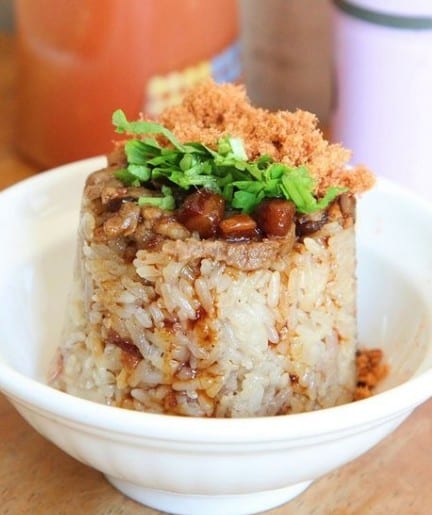
Tainan glutinous rice bowl is a traditional bowl-style rice dish made by steaming round glutinous rice until soft and sticky, then topping it with braised pork, shrimp, and egg — a signature morning-market and late-night staple distinct from northern-style cylinder-steamed mi gao. Several long-standing shops around Guohua Street and Shi Jing Jiu in Zhongxi District have kept their own recipes for decades, some nearly a century, each with its own loyal following.
The place name Shi Jing Jiu originates from the Qing-to-Japanese-colonial era, when Xinmei Street (formerly Rice Street) thrived on the rice trade and shops used stone mortars ('shi chong khu' in Taiwanese Hokkien) to pound rice, giving the area its name. Cai's Rice Cake inside the Shi Jing Jiu snack complex has been run by the same family since the first generation started selling in 1927, nearly 90 years; Shuixian Temple Rice Cake near Guohua Street has been operating since 1956, over 60 years. (Source: field records from itainan.com.tw, dtmsimon.com, daisycc.com)
What Is Tainan Glutinous Rice Bowl
Tainan glutinous rice bowl starts with round glutinous rice steamed in a bamboo steamer until soft and sticky, then ladled into a bowl and layered in order with braised pork (lu rou with its braising sauce), shrimp, and an egg (braised egg or quail egg), finished with a pour of rich sauce. The rice is sticky and absorbent, taking on complex depth from the sauce. The braised pork is the soul — each shop's sauce has its own sweet-to-savory ratio and depth of fat. Unlike northern-style cylinder glutinous rice (tong zai mi gao, steamed in bamboo tubes and unmolded), the Tainan version is served freely in a bowl with abundant toppings.
Tainan glutinous rice bowl is a traditional staple for both morning market breakfasts and late-night meals, ranking alongside milkfish congee and beef soup as one of the three main Tainan breakfast options, each with its own devoted following. Zhou Ji Glutinous Rice and Shi Jing Jiu Glutinous Rice are two well-known long-standing shops in Zhongxi District, each with loyal regulars and different details in their recipe and toppings. The sweet-to-savory ratio and sauce profile are unique to Tainan's food coordinates. First-time visitors are advised to arrive before 7 a.m. to avoid selling out — even earlier during peak seasons.
How to Eat It Like a Local
Local Knowledge
Background
- Tainan glutinous rice bowl is made by steaming round glutinous rice and topping it with braised pork, shrimp, and eggs — a traditional Tainan morning market staple, distinct from northern-style cylinder glutinous rice (steamed in bamboo tubes).
- Zhou Ji Glutinous Rice and Shi Jing Jiu Glutinous Rice are two well-known long-standing shops in Zhongxi District, both near Guohua Street, each with their own fixed recipe and loyal following. Trying one bowl at each is recommended.
- Tainan glutinous rice bowl is a pilgrimage-level dish and an essential reference point for understanding Tainan food culture. The richness of toppings and the sweet-to-savory sauce balance are unique to Tainan's food coordinates.
Visitor Tips
- Popular long-standing shops can sell out around 8 a.m. during peak season. During holiday weekends, arrive before 7 a.m. Weekdays allow a bit more leeway.
- The Guohua Street area is densely crowded in the morning on weekends, and parking is difficult. Public transit or cycling is recommended — Tainan city has a well-developed cycling network.
- One bowl of Tainan mi gao is a moderate portion. You can continue on to nearby stalls for other snacks right after — leave room in your stomach.
Source: Food culture records of Zhongxi District, Tainan, and current field notes on the Guohua Street morning market.
Frequently Asked Questions
How is Tainan glutinous rice bowl different from northern cylinder-steamed mi gao?
Tainan's version is served freely in a bowl with abundant toppings, while northern-style mi gao is steamed in a bamboo cylinder and unmolded — the two use different techniques.
Where does the place name Shi Jing Jiu come from?
It comes from the Qing-to-Japanese-colonial era, when Xinmei Street thrived on the rice trade and shops used stone mortars to pound rice, giving the area its Taiwanese Hokkien name.
How old are Tainan's oldest rice cake shops?
The oldest shops around Shi Jing Jiu trace back to 1927, nearly 90 years ago, while shops near Guohua Street mostly opened around 1956, over 60 years ago.
Sources
- 石精臼點心城美食,默默走過90年歷史的老店米糕「蔡家米糕」 - itainan.com.tw — 蔡家米糕自民國16年(1927)第一代擺攤,近90年歷史
- 石精臼 蔡家米糕 - dtmsimon.com — 交叉驗證蔡家米糕1927年起源
- 水仙宮米糕,飄香台南國華街 - daisycc.com — 水仙宮米糕自民國45年(1956)起,超過一甲子