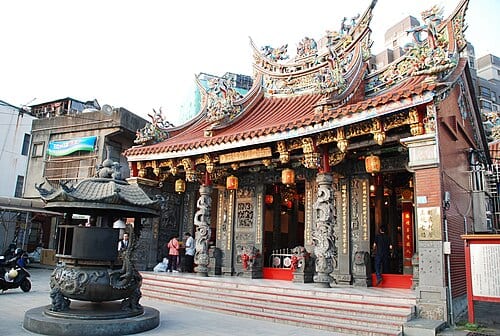
Nankan Wufu Temple is a temple in Nankan, Luzhu District, Taoyuan, dedicated primarily to Marshal Zhao Gongming, the God of Wealth, with origins traditionally traced to around 1661 during the Ming-Zheng period — making it one of Taoyuan's oldest surviving temples. It was designated a third-grade national monument in 1985 and redesignated a special-municipality monument after Taoyuan was upgraded in 2014. The temple's architecture follows traditional Minnan craftsmanship and has been included among Taiwan's 100 Religious Landscapes; its forecourt remains an important gathering space for local festivals and folk activities.
Nankan Wufu Temple's primary deity is Marshal Zhao Gongming, the God of Wealth — not the Earth God (Tudigong) as sometimes assumed. Its origin is traditionally traced to 1661, when Ming-Zheng loyalist troops brought the deity's incense to the site; sources vary on the exact founding date (1663 or 1682 are both cited), making it one of Taoyuan's oldest surviving temples. It was designated a third-grade national monument on August 19, 1985, redesignated a county monument in 1997, and became a special-municipality monument in 2014 when Taoyuan was upgraded. The temple also preserves a nearly 200-year-old stone incense burner cast in 1823.
Highlights of Nankan Wufu Temple
The Wufu Temple architecture follows the traditional Minnan temple form. The roof ridges feature jiǎn niān (cut-and-paste ceramic) craft depicting mythological scenes; the main hall shrine layout is solemn; and the side護龍 rooms retain traditional architectural vocabulary. The temple has undergone multiple renovations, and its current appearance blends craft styles from different periods. The painted murals and stone-carving details are worth a close look, especially the stone lions at the temple gate and the wall-panel relief carvings, which are in relatively good condition.
Nankan Wufu Temple has been included among Taiwan's 100 Religious Landscapes, reflecting its representative status in local faith and culture. The temple forecourt is the principal public gathering space in the Luzhu Nankan area. During lunar calendar festivals — such as Lantern Festival, Mazu processions, and Tudigong's birthday — various folk activities are held here, making it one of the most accessible places to observe the everyday workings of Taiwanese folk religion.
How to Make the Most of Your Visit
Practical Information
Getting There & Timing
- Located in Nankan, Luzhu District. Convenient to access — take the Taoyuan MRT to A8 Nankan Station then transfer by taxi or walk. By car, roadside parking near the temple or a nearby car park is available.
- The temple is open at all times with no admission fee. The morning of the 1st or 15th day of each lunar month tends to have more incense activity — a good time to experience local faith traditions.
Nearby Connections
- Dagushan Viewpoint (sp-ty-23) is about 5 minutes by car from the temple — the two can be combined as a Luzhu Nankan half-day outing.
- Taoyuan Airport's Terminal 1 and 2 are about 15 minutes from Nankan — a convenient add-on when dropping off or picking up passengers.
Sources: Taiwan's 100 Religious Landscapes database, Taoyuan City Government Cultural Affairs Bureau data.
Frequently Asked Questions
Who is the main deity worshipped at Nankan Wufu Temple?
Nankan Wufu Temple's primary deity is Marshal Zhao Gongming, the God of Wealth — not the Earth God (Tudigong).
When was Nankan Wufu Temple founded?
Its origins are traditionally traced to 1661 during the Ming-Zheng period, with founding-date records varying between 1663 and 1682.
What is the temple's monument status?
It was designated a third-grade national monument in 1985, redesignated a county monument in 1997, and became a special-municipality monument in 2014.
What notable artifact does the temple preserve?
The temple preserves a stone incense burner cast in 1823, nearly 200 years old, regarded as its treasure.
Sources
- 南崁五福宮 - 臺灣宗教文化地圖 — 內政部民政司官方宗教文化地圖,主祀神明與建廟年代
- 蘆竹五福宮 - 維基百科 — 古蹟等級公告年份、文物資訊