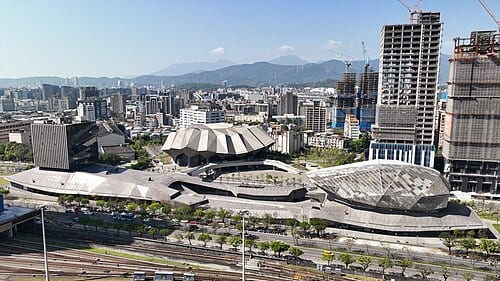
Taipei Music Center is a dedicated pop-music venue that opened in 2020, designed jointly by the US firm RUR Architecture and Taiwan's Zongmai Architects. It comprises two buildings — a performance hall and a cultural hall — with a metal mesh facade evoking sound-wave diffraction; it is currently Taiwan's highest-specification popular music venue, located along Civic Boulevard in Nangang District.
Taipei Music Center held its opening ceremony on August 27, 2020, and began full operation on September 5, 2020. The venue was designed jointly by US firm RUR Architecture and Taiwan's Zongmai Architects; the performance hall has about 3,100 fixed seats and can hold up to roughly 5,000 people in a standing configuration. (Source: Chinese Wikipedia entry for Taipei Music Center; MeMeOn)
Highlights of Taipei Music Center
The two buildings of Taipei Music Center serve distinct functions. The performance hall (TMC Live House) is primarily designed for 6,000-seat indoor concerts and is one of the largest indoor performance venues in Taiwan's pop music scene. The cultural hall houses a permanent exhibition tracing the history of Taiwanese popular music, with ticket prices significantly lower than concert tickets. The two buildings are connected at the basement level, and the exterior makes a striking visual impression under nighttime lighting.
The cultural hall's exhibition uses the history of Taiwanese popular music as its thread, spanning from early folk songs to the contemporary music scene, with interactive displays and an audio-visual archive viewing area. For visitors without concert plans, the cultural hall's permanent exhibition is the main way to experience the venue. Concert tickets are sold through major ticketing platforms and must be purchased in advance; there is no walk-in admission to the performance hall without a ticket.
Tips for Getting the Most Out of Your Visit
Practical Information
Getting There and Timing
- Take the MRT Bannan Line to Nangang Exhibition Hall Station and walk about 5 to 10 minutes to the venue on Section 8, Civic Boulevard.
- For cultural hall opening hours and ticket prices, please check the Taipei Music Center official website. Concert tickets for the performance hall are available through major ticketing platforms.
Nearby Connections
- Nangang Exhibition Hall and the shops at Nangang Station are within walking distance and are convenient for a meal or shopping after your visit.
- The MRT Bannan Line connects directly to Xinyi District. If you have a performance booking, you can extend your evening to the area around Taipei 101.
Frequently Asked Questions
When did Taipei Music Center open?
Its opening ceremony was held on August 27, 2020, with full operation beginning September 5, 2020.
Who designed Taipei Music Center?
It was designed jointly by RUR Architecture (US) and Zongmai Architects (Taiwan).
How many people can the performance hall hold?
It has about 3,100 fixed seats and can hold roughly 5,000 in a standing configuration.
Sources
- 臺北流行音樂中心 - 維基百科 — 設計者、開幕日期、座位數
- 臺北流行音樂中心容納人數/交通/寄物櫃 - MeMeOn 迷迷音 — 容納人數資訊