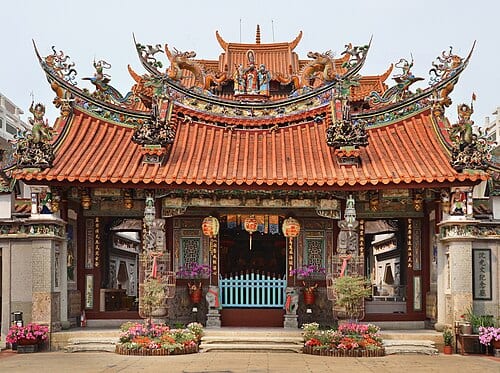
Shanhua Qingan Temple is a temple in Shanhua District, Tainan, dedicated to the Heavenly Holy Mother. Its predecessor was a Wenchang shrine established during the Kangxi reign of the Qing dynasty; after an 1862 earthquake destroyed the shrine, it was rebuilt between 1864 and 1865 with Mazu installed as the principal deity and renamed Qingan Temple. Designated a protected historic monument in 1997, its main hall still retains stonework from the Jiaqing era and wooden structural elements from the Tongzhi era.
The site of Shanhua Qingan Temple traces back to a Wenchang shrine established during the Qing Kangxi reign (with an earlier legend citing a Dutch-built church on the site in 1636). A major earthquake in southern Taiwan on the eleventh day of the fifth lunar month of the Tongzhi reign's first year (June 7, 1862) destroyed the Wenchang shrine; local residents raised funds to rebuild it between 1864 and 1865, installing Mazu as the principal deity and renaming it Qingan Temple. The main hall was rebuilt in 1947, though it still retains stonework from the Jiaqing era and wooden structural elements from the Tongzhi era; the temple was designated a third-grade historic monument in 1997 (now reclassified as a municipal historic monument).
Highlights of Shanhua Qingan Temple
Shanhua Qingan Temple stands on Zhongshan Road in Shanhua District, Tainan City. As the main temple of the district, it is dedicated to the Heavenly Holy Mother (Mazu), with a history of temple-building that traces back to the Qing dynasty. The temple follows the sanchuan-dian layout, with flanking wings on either side of the main hall forming a complete traditional temple space. After multiple renovations, the current structure preserves stone carvings from the Qing dynasty to the modern era, as well as colorful jianjian mosaic work. The ornate roof ridge decorations are well worth studying closely.
The Shanhua Old Street (along Zhongshan Road) surrounding the temple retains some Japanese colonial-era shophouse buildings. Their facade ornamentation reflects the neo-Baroque and eclectic modernist styles common in Taiwan during the Japanese period. While the street is no longer preserved in its entirety, scattered historic facade elements are still visible. Shanhua is a transportation hub in central Tainan; the district has a full range of everyday amenities, and the temple forecourt market is a snapshot of local daily life.
How to Make the Most of Your Visit
Practical Information
Getting There & Time
- From central Tainan, the drive takes about 25 minutes, or take the Taiwan Railways to Shanhua Station and walk approximately 10–15 minutes. Shanhua is served by Tainan City bus routes, making it relatively accessible by public transport.
- The temple is open year-round. For daily opening hours, check the temple's official notices. The Japanese colonial shophouses are within walking distance of the temple and are best viewed during the day when natural light is good.
Nearby Connections
- Xigang Qingan Temple is about 20 minutes from Shanhua by car — it can be linked into a central Tainan temple culture route.
- Zouma Creek Farm is about 20–25 minutes away, making it possible to combine a morning of temple culture with an afternoon at the farm.
Source: and the Wikipedia article on Shanhua Qingan Temple.
Frequently Asked Questions
What was Shanhua Qingan Temple originally?
Shanhua Qingan Temple's predecessor was a Wenchang shrine established during the Qing Kangxi reign; it was rededicated to Mazu and renamed after an 1862 earthquake destroyed the original structure.
When did the temple start enshrining Mazu?
The temple began enshrining Mazu as its principal deity only after its 1864–1865 reconstruction; before that it was dedicated to Wenchang Dijun.
What Qing-dynasty relics does the temple retain?
Though the main hall was rebuilt in 1947, it still retains stonework from the Jiaqing era and wooden elements from the Tongzhi era, and was designated a historic monument in 1997.
Sources
- 善化慶安宮 - 維基百科 — 前身文昌祠、1862年地震與改祀媽祖沿革
- 歷史溯源-善化慶安宮 — 廟方官方沿革
- 善化慶安宮三級古蹟,古蹟巡禮配上善化老街美食簡直絕配! — 1997年古蹟公告與清代石雕遺構