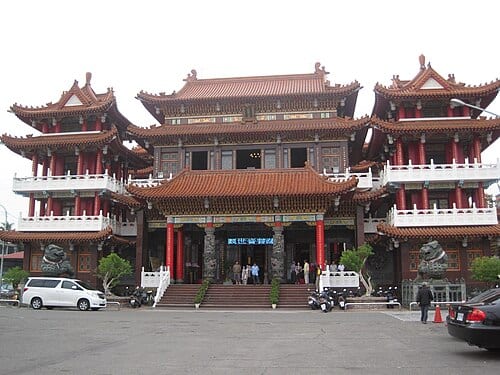
Guanmiao Shanxi Temple is a temple in Guanmiao District, Tainan, dedicated to Guan Sheng Di Jun, said to have been founded during the Zheng Chenggong era and rebuilt as a formal temple by the prefect in the 27th year of the Qianlong reign (1762); the district name "Guanmiao" itself derives from this temple. The current main building was completed in 1982, while the old temple structure and carvings, rebuilt during the Japanese colonial era (1933), still stand preserved to the north.
Guanmiao Shanxi Temple is said to have been founded during the Zheng Chenggong era, and was rebuilt as a formal temple by the prefect in the 27th year of the Qianlong reign (1762); Guanmiao District itself takes its name from this temple. The current main structure broke ground in 1975 and, after seven years and seven months of construction, was completed in December 1982. The dragon pillars, stone wall carvings, and spider-web wood carving preserved in the old temple building to the north have been verified as dating from a 1933 expansion during the Japanese colonial era — not from the Qing dynasty as sometimes claimed — making them a rare surviving example of 1930s temple craftsmanship in Guanmiao.
Highlights of Guanmiao Shanxi Temple
Guanmiao Shanxi Temple stands on Zhongzheng Road in Guanmiao District, Tainan City. Founded during the Mingzheng period, the temple is dedicated to Guan Sheng Di Jun (Guan Yu) and serves as the spiritual core of Guanmiao District. The very place name "Guanmiao" (Temple of Guan) derives from this temple, reflecting its historical significance to the formation of the local settlement. The temple has been repaired and rebuilt multiple times across the Qing dynasty, the Japanese colonial era, and the postwar period. The current structure blends construction techniques from different eras and still retains some Qing-dynasty wooden structural carvings of historical and cultural value.
The temple follows the sanchuan-dian (three-nave hall) layout. The paired inscriptions on the main gate, the painted door gods, and the altar decorations inside all maintain traditional forms, creating an atmosphere of solemn reverence. The plaza in front of the temple is the central venue for public activities in Guanmiao District — bustling during temple festivals and, on ordinary days, a place to experience the everyday rhythm of a traditional Tainan temple forecourt. The surrounding blocks also preserve some traditional shophouse facades.
How to Make the Most of Your Visit
Practical Information
Getting There & Time
- From central Tainan, the drive takes approximately 25–30 minutes south along Provincial Highway 1 to Guanmiao District. Tainan City buses also serve Guanmiao, but service is infrequent — check schedules in advance.
- The temple is open year-round. For daily opening hours, check the temple's official notices or confirm on-site. Incense traffic is heaviest around major lunar festival dates.
Nearby Connections
- Longqi Niupu Badlands is approximately 15–20 minutes southeast of Guanmiao by car, making it possible to combine a Tainan southern natural landscape and temple culture itinerary.
- Guiren Renshou Temple in Guiren District is about 15 minutes away. Visitors with an interest in Tainan temple architecture can extend their trip there.
Source: and the Wikipedia article on Guanmiao Shanxi Temple.
Frequently Asked Questions
When was Guanmiao Shanxi Temple founded?
Guanmiao Shanxi Temple is said to have been founded during the Zheng Chenggong era and was rebuilt as a formal temple by the prefect in 1762.
Where does the name "Guanmiao" come from?
The district name "Guanmiao" derives from this temple, dedicated to Guan Sheng Di Jun, reflecting the temple's role in the area's early settlement history.
Are the wood and stone carvings preserved at the temple from the Qing dynasty?
The dragon pillars and carvings preserved in the old temple building to the north date from a 1933 expansion during the Japanese colonial era, not the Qing dynasty.
Sources
- 關廟山西宮 - 維基百科 — 建廟年代、1982年重建與1933年舊廟雕刻年代
- 臺南市關廟區公所-關廟山西宮 — 地名由來與廟史