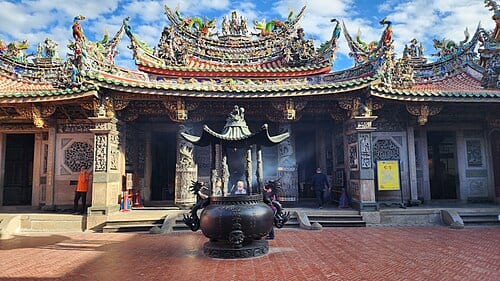
Nankunshen Daitian Temple is a Wang Ye worship temple in Beimen District, Tainan, enshrining the Five Lords — Li, Chi, Wu, Zhu, and Fan — and known as the "Main Temple of Wang Ye Worship in Taiwan," with devotees spanning Taiwan and Southeast Asia. The temple was first built in 1662 (the Ming Yongli era), destroyed by coastal storms, then relocated and rebuilt starting in 1817 (the Qing Jiaqing era) and completed in 1822 (the Daoguang era); its halls are richly decorated in gold. Beside the main temple, Wanshan Hall enshrines Jiazai Gong, forming a distinctive local folk belief system — the most important religious site along the Beimen coast of northern Tainan.
Nankunshen Temple was first built on the Nankunshen sandbar in 1662 (the Ming Yongli era, coinciding with the first year of the Qing Kangxi era), but was later destroyed by heavy waves. It was rebuilt starting in 1817 (the Jiaqing era) at Hufeng on Kanglangshan hill, a project taking more than five years to complete in 1822 (the Daoguang era), when it was named Nankunshen Daitian Temple. The temple enshrines the Five Lords — Li, Chi, Wu, Zhu, and Fan — said in tradition to have been five sworn brothers from the late Sui dynasty.
What to see at Nankunshen Daitian Temple
Nankunshen Daitian Temple is located in Kunjiangli, Beimen District, Tainan. The temple's history can be traced back to the early Qing dynasty. It enshrines the Five Lords: Li, Chi, Wu, Zhu, and Fan. The temple complex has been expanded many times over the centuries, and today its scale is considerable — the main hall, rear halls, bell and drum towers, and mountain gate form an imposing architectural ensemble. The broad plaza in front of the temple sees streams of worshippers during major ceremonies, making this one of the most important pilgrimage sites for Wang Ye worship in Taiwan.
Wanshan Hall beside the temple enshrines "Jiazai Gong" — according to tradition, the spirits of a group of children who perished in the area and were later venerated by believers — forming a local belief tradition that differs from the main deity enshrined in the principal hall, and holding unique interest for folklore studies. The temple precinct as a whole covers a large area, with refined decorative craftsmanship on display throughout: Jiaozhi pottery, cut-and-paste mosaic (jianzhan), wood carvings, and more. Major ceremonies such as the Wang Ye birthday observances are celebrated on a grand scale — consulting the temple's lunar calendar of events beforehand is worthwhile if you're interested.
Tips for getting the most out of your visit
Practical information
Getting there and time needed
- Located in Kunjiangli, Beimen District, Tainan. Driving or riding a scooter is the most convenient option. There is a parking lot in front of the temple, though it gets crowded on major holidays.
- The temple is open year-round. Worshippers and visitors increase substantially during major ceremonies. For those who prefer a quieter visit, weekdays are a better choice.
Nearby connections
- Beimen Lagoon and Jingzijiao Tile-Pan Salt Fields are both in Beimen District. One option is to visit the salt fields in the afternoon for the sunset, then head to Nankunshen in the evening or the following day.
- Jiali District is within the nearby area. Extending the trip to Jiali Jintang Temple to see Ye Wang's Jiaozhi pottery provides a full experience of the temple craft culture of northern Tainan.
Source: Wikipedia entry on Nankunshen Daitian Temple and official temple information.
Frequently Asked Questions
When was Nankunshen Daitian Temple built?
It was first built on the Nankunshen sandbar in 1662, destroyed by storms, then rebuilt starting in 1817 and completed in 1822.
Which deities does Nankunshen Daitian Temple enshrine?
It enshrines the Five Lords — Li, Chi, Wu, Zhu, and Fan — said in tradition to have been five sworn brothers from the late Sui dynasty.
What is enshrined at the adjacent Wanshan Hall?
It enshrines Jiazai Gong, said in tradition to be the spirits of children who died in the area and were later venerated by believers, forming a distinctive local belief.
Sources
- 南鯤鯓代天府 - 維基百科 — 廟史沿革:1662年首建、1817年遷建、1822年完工,五府千歲典故