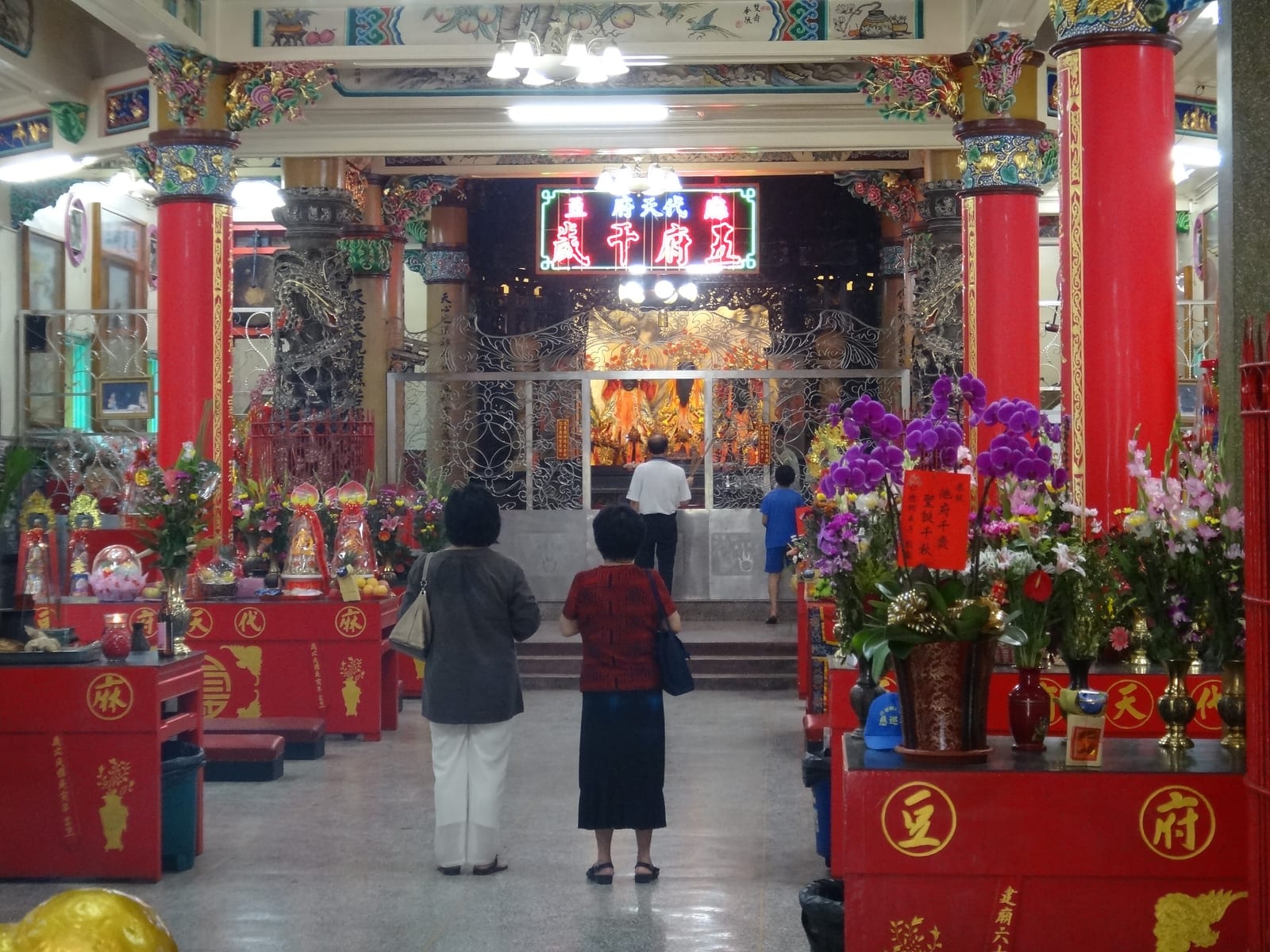
Madou Daitian Temple is a Taoist temple in Madou District, Tainan, enshrining the Five Lords (Li, Chi, Wu, Zhu, and Fan); its worship lineage traces back to Baoning Temple, founded in 1662, though the current temple building was constructed starting in 1956. Beside it stands the Zongye Arts and Cultural Center, converted from a Japanese-colonial-era sugar factory — a thriving Wang Ye temple on one side, a repurposed sugar-mill exhibition space on the other, together forming Madou's most distinctive spatial combination.
The present Daitian Temple building was constructed starting in 1956, completed in stages through 1966; its worship lineage traces back to a brick shrine called Baoning Temple built by early settlers in 1662, which was relocated and renamed Baoan Temple in 1857. The temple's Rainbow Dragon — a 76-meter-long, 7-meter-tall dragon structure containing 'heaven' and 'hell' exhibition areas — was built in 1979. The adjacent Zongye Arts and Cultural Center was originally the Meiji Sugar Manufacturing Company's Madou factory, established around 1909 and formally operational from 1912.
What to See at Madou Daitian Temple
Madou Daitian Temple enshrines Lord Chi and has a temple history of over three hundred years, making it the most important religious center in Madou District. The temple architecture is large in scale; the main hall and flanking halls feature refined decorations, with traditional temple art techniques such as jiaozhi pottery and jiannie mosaic on full display across the facades. Beside the temple, the Hell Eighteen Levels Scenic Area presents a visual representation of the underworld as depicted in folk belief, with scene designs characteristic of local folk religious culture.
The Zongye Arts and Cultural Center beside the temple is converted from the former Madou Zongye factory of the Meiji Sugar Manufacturing Company during the Japanese colonial period, retaining the spatial framework of the sugar mill. Now used as an arts and performance venue, the spacious factory space has intact beams and brick walls. It is one of Taiwan's examples of sugar mill adaptive reuse. The two can be visited in the same afternoon.
How to Make the Most of Your Visit
Practical Information
Getting There & Timing
- Located on Guandi Temple Street in Madou District, about 30 km from central Tainan; driving or taking a long-distance bus is recommended — check Tainan bus routes for schedules.
- The temple is generally open all day; the Zongye Arts and Cultural Center has set exhibition hours — check the website to confirm access before you go.
- The Madou pomelo season is approximately the eighth lunar month (around September), so if you visit during the season you can buy local.
Nearby Connections
- Madou Old Street retains some Japanese-colonial architecture and is about a 10-minute walk from the temple — good for an extended stroll to understand how Madou's streets developed.
- Zengwen Reservoir is about a 40-minute drive from Madou — those with energy and time can plan a half-day extension.
For exhibition schedules at the Zongye Arts and Cultural Center, please consult official announcements from the Tainan City Bureau of Cultural Affairs.
Frequently Asked Questions
Which deities does Madou Daitian Temple enshrine?
It enshrines the Five Lords — Li, Chi, Wu, Zhu, and Fan — and is regarded as a founding head temple for Five Lords worship in Taiwan.
How old is Madou Daitian Temple?
Its worship lineage traces back to Baoning Temple, founded in 1662 — over three centuries — though the current temple building was constructed starting in 1956.
How is the Zongye Arts and Cultural Center related to the temple?
It is a converted Japanese-era sugar factory directly beside the temple, sharing the same grounds and easily visited in one afternoon.
When was the Rainbow Dragon built?
The colorful Rainbow Dragon was built in 1979, measuring 76 meters long and 7 meters tall, with heaven and hell exhibition areas inside.
Sources
- 麻豆代天府 - 維基百科 — 廟史沿革、觀光巨龍規模
- 建廟緣起沿革 - 麻豆代天府 — 官方建廟歷史
- 總爺藝文中心|認識總爺|園區沿革 — 糖廠設立年代