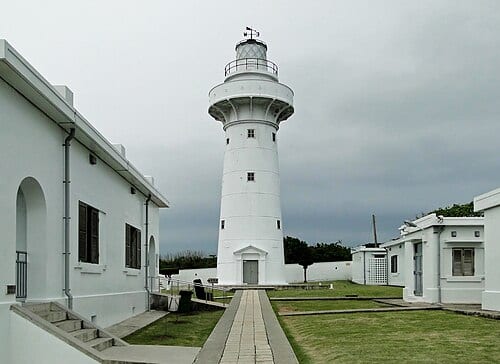
Eluanbi Lighthouse is Taiwan main island's southernmost lighthouse, begun in 1881 and lit in 1883; it stands 21.4 meters tall and, after a 1962 equipment upgrade, now emits 1.8 million candela visible to about 27.2 nautical miles, making it Taiwan's most powerful lighthouse in service. Its white circular iron tower stands alongside the ruins of armed gun emplacements, making it Taiwan's only armed lighthouse.
Eluanbi Lighthouse was begun in the 7th year of the Guangxu reign (1881) and formally lit in 1883 (Guangxu 9); it stands 21.4 meters tall. After equipment was upgraded in 1962, it now uses a fourth-order rotating lens light with an intensity of 1.8 million candela, visible to about 27.2 nautical miles. Following the 1867 Rover Incident and the subsequent diplomatic pressure from the 1874 Mudan Incident, the Qing court commissioned British surveyor Michael Beazeley to identify a site and purchased land from the Kuizairut community to build the lighthouse, which was equipped with gun emplacements and a moat — making it Taiwan's only armed lighthouse.
Highlights of Eluanbi Lighthouse
The construction of Eluanbi Lighthouse is closely related to the development of southern Taiwan following the late-Qing Mudan Incident. In 1867, American sailors were killed near Eluanbi by indigenous people, triggering a diplomatic incident. The Qing court therefore decided to establish a lighthouse here and, due to security concerns, constructed armed gun emplacements and a moat around it, making it the only armed lighthouse in Taiwan. The surviving gun emplacement ruins can still be seen within the park, bearing witness to this complex historical context. The lighthouse tower stands 21.4 meters tall, built from cast iron assembled in sections, and is one of the most important surviving Qing-dynasty lighthouses in Taiwan.
The lighthouse park (Eluanbi Park) is planted with tropical flora and features lawns and coral reef trails. It is one of the most heavily visited scenic spots in southern Taiwan. The park contains the gun emplacement ruins, a lighthouse interpretation center, and a tropical coastal forest trail. The cape juts out at the confluence of the Bashi Channel and the Taiwan Strait; on clear days, you can see out to the open sea. It is the most southerly accessible land point on the Taiwan main island. During the Luoshan wind season (autumn and winter), winds are strong at the cape; keep warm and secure hats and other light items.
How to make the most of your visit
Practical information
Getting there and timing
- Eluanbi Park is at the southern end of Kenting Main Street, about 5 km from the Kenting commercial district. You can take the Kenting shuttle bus or rent a scooter to get there. The park is open year-round and charges an entry fee; please check the Kenting National Park Headquarters official website for the current price.
- Parking spaces are tight on summer weekends; public transport is recommended, or avoid the peak period between 10 a.m. and 3 p.m.
- During the Luoshan wind season (approximately October to March of the following year), winds are strong; gusts at the cape are even stronger. Dress warmly and secure hats and other light items when visiting.
Nearby connections
- Maobitou Park is on the west side of Eluanbi, about 15 km away — also a landmark at the southern tip of the Hengchun Peninsula. Visiting both capes in one day makes for an interesting comparison.
- Longken Ecological Reserve is to the northeast of Eluanbi and is an important coral reef ecological reserve within Kenting National Park. Entry permits are required; contact the Kenting National Park Headquarters before visiting.
- Kenting Baishawan Beach is about 10 km from Eluanbi and can serve as a beach extension before or after the itinerary.
Sources: Maritime and Port Bureau, Ministry of Transportation (lighthouse records); Kenting National Park Headquarters; Bureau of Cultural Heritage, Ministry of Culture.
Frequently Asked Questions
Why is Eluanbi Lighthouse an armed lighthouse?
The Qing court decided to build it under diplomatic pressure following the 1867 Rover Incident and the subsequent Mudan Incident, equipping it with gun emplacements and a moat, making it Taiwan's only armed lighthouse.
How powerful is Eluanbi Lighthouse's light?
After a 1962 equipment upgrade, it emits 1.8 million candela visible to about 27.2 nautical miles, making it Taiwan's most powerful lighthouse in service.
When was Eluanbi Lighthouse completed?
It was begun in 1881 (Guangxu 7) and formally lit in 1883 (Guangxu 9).
Sources
- 鵝鑾鼻燈塔 - 維基百科 — 建造年份、塔高、光力、羅妹號事件因果
- 鵝鑾鼻燈塔 - 燈塔資訊 - 交通部航港局 — 官方燈塔規格資料