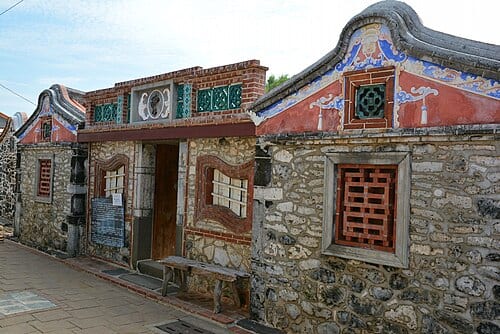
Huazhai Village is one of the most intact traditional Han Chinese settlements preserved in Penghu, first announced as a cultural heritage 'settlement' in 2006 and officially registered in 2010 as Taiwan's first nationally designated 'Important Groups of Historic Buildings.'
Huazhai Village was first announced as a cultural heritage 'settlement' on December 27, 2006, and was officially registered as Taiwan's first nationally designated 'Important Groups of Historic Buildings' on April 14, 2010. Most of its buildings are constructed from local Penghu basalt and coral reef stone, reflecting residents' traditional wisdom of building with locally available materials.
Highlights of Huazhai Village
The core material of Huazhai Village is gu gu stone — coral reef rock — which traditional Penghu dwellings use for walls, with lime as the binding agent. It is highly weather-resistant and harmonizes with the local basalt landscape. The alley layout of the settlement preserves the traditional arrangement from the Qing dynasty; the narrow lanes winding between courtyards effectively block Penghu's powerful northeast monsoon. The double-happiness-shaped window decorations on the outer walls are the defining architectural feature of the buildings, rendered in stone masonry or brick techniques with neat, intricate patterns — a tangible reference for traditional Penghu building craftsmanship.
Because most of the buildings are now uninhabited, the settlement has a quiet atmosphere. Some houses still retain their original wooden doors and window frames, though the degree of aging varies. When visiting, observe from an appropriate distance and avoid entering buildings with obvious structural damage; if you encounter an occupied house, respect the residents' privacy. The settlement can be entered freely with no admission fee. It is recommended to allow at least one hour for a slow exploration, paying attention to the differences in the double-happiness window decorations, lime-mortar jointing techniques, and spatial layout details of each courtyard.
How to make the most of it
Practical information
Getting there & timing
- Wang'an Township requires a ferry from Magong; check the Penghu County Government or shipping company's official website for ferry schedules, as departures vary by season. Huazhai Village is in Zhongshe Village, about a 10-minute ride from Wang'an Harbor.
- The settlement can be entered freely at no charge with no fixed opening hours, but a daytime visit is recommended to ensure safe visibility and observation quality.
Nearby connections
- Huazhai Village is in the center of Wang'an Island and can be combined with Tiantai Mountain (52 meters above sea level, Wang'an's highest point) and Wangan Beach for a full-day Wang'an itinerary.
- Near Zhongshe Village there is a Tianhou Temple and other temples that can be visited to observe the architectural style of temples on Penghu's outer islands.
Sources: and Penghu County Cultural Affairs Bureau cultural landscape registration data (2001).
Frequently Asked Questions
When was Huazhai Village designated a cultural heritage site?
It was first announced as a 'settlement' on December 27, 2006, then officially registered on April 14, 2010 as Taiwan's first Important Groups of Historic Buildings.
What materials were used to build Huazhai Village?
Mainly local Penghu basalt and coral reef stone for the walls, with lime as the binding mortar.
Is anyone still living in the settlement?
Most houses are now uninhabited, though a few still have residents; visitors should keep a respectful distance and avoid disturbing their privacy.
Sources
- 望安花宅聚落-國家文化資產網 — 登錄公告日期(2010年4月14日)
- 望安花宅聚落-維基百科 — 2006年公告為聚落、2010年登錄重要聚落建築群之沿革交叉核對