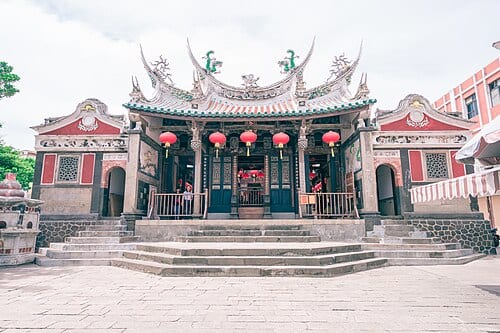
Penghu Tianhou Temple is a Mazu temple in Magong, Penghu, historically recorded as the oldest in Taiwan and now designated a National Historic Site at the entrance to Zhongyang Old Street. Inside stands the stele "Shen Yourong Yutui Hongmaofan Weimalang Deng," unearthed during a 1919 renovation and named a National Treasure in 2022 — the oldest surviving inscribed stele in Taiwan, commemorating the 1604 negotiation that led Dutch commander Wybrand van Warwijck to leave Penghu.
Penghu Tianhou Temple was among the first batch of 15 first-class historic sites designated by Taiwan's Ministry of the Interior on December 28, 1983, and was redesignated a National Historic Site after a 1997 revision of the heritage grading system. The stele inside, "Shen Yourong Yutui Hongmaofan Weimalang Deng," was unearthed during a 1919 renovation, measures 200 cm tall, 28 cm wide, and 14 cm thick, and was designated a National Treasure by the Ministry of Culture on March 8, 2022 — the oldest surviving inscribed stele in Taiwan, recording the 1604 negotiation in which Ming commander Shen Yourong persuaded Dutch commander Wybrand van Warwijck to withdraw from Penghu.
Highlights of Penghu Tianhou Temple
The temple's founding dates to the Ming Dynasty; Dutch records from 1604 document its existence, making it the earliest Mazu temple in Taiwan by historical record. Though the site has been rebuilt multiple times, the existing structure retains Qing Dynasty craftsmanship. Inside are stone steles, gilded plaques, and ritual objects from the Qing era — key physical evidence for studying early Taiwanese religious history.
The temple follows a three-hall longitudinal layout — front hall, main hall, and rear hall. The ridge ornamentation features intricate jianjian mosaic work, and the upturned swallow-tail eaves are a hallmark of Minnan temple design. The stone column carvings and painted murals preserve Qing Dynasty artisan techniques. The temple's proximity to the adjacent central old street makes this area the densest cluster of historical heritage in Magong.
Tips for Getting the Most Out of Your Visit
Practical Information
Getting There & Time
- Located on Zhengyi Street in Magong City, about a 5–10 minute walk from the city center, easily reached on foot or by scooter.
- Open all day; no fixed admission fee. Please avoid disrupting ongoing religious ceremonies.
- Allow 30–45 minutes, including the temple artifacts and the nearby old street.
Nearby Connections
- Directly adjacent to Zhongyang Old Street — walk over and explore Magong's historic settlement layout together.
- Shuncheng Gate (a Qing Dynasty city gate ruin) is within walking distance, forming a walkable heritage route through Magong.
Sources: Cultural Heritage Bureau, Ministry of Culture (National Historic Site records).
Frequently Asked Questions
When was Penghu Tianhou Temple built?
The exact founding date is unknown, but the stele discovered inside confirms the temple already existed before 1604, making it the oldest Mazu temple in Taiwan.
What is the National Treasure stele at the temple?
It is the "Shen Yourong Yutui Hongmaofan Weimalang Deng" stele, unearthed in 1919 and designated a National Treasure in 2022 — the oldest surviving inscribed stele in Taiwan.
When was it designated a National Historic Site?
It was first designated a first-class historic site on December 28, 1983, and became a National Historic Site after the 1997 heritage grading revision.
Sources
- 澎湖天后宮 - 維基百科 — 創建年代與古蹟沿革
- 沈有容諭退紅毛番韋麻郎等碑 - 維基百科 — 石碑年代與國寶公告
- 澎湖天后宮 > 觀光景點 > 交通部觀光署 — 官方觀光資訊