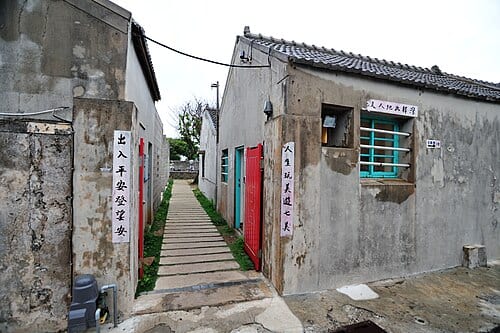
Duxing 10th Village is one of the earliest military dependants' villages formed in Taiwan and Penghu, originally built as officers' quarters for the Japanese-era Penghu Fortress Command and the Magong Heavy Artillery Battalion. Designated a historic building in 2007, it was fully restored by the end of 2012 and reopened as a juancun cultural park. Singers Pan An-pang and Chang Yu-sheng both grew up here, and their former homes are now memorial museums.
Duxing 10th Village was originally built as officers' quarters for the Japanese-era Penghu Fortress Command and the Magong Heavy Artillery Battalion; after the war it was taken over by the Penghu Defense Command as military family housing. The Penghu County Government designated it a historic building on November 21, 2007, and zoned it a special juancun heritage district, with restoration completed by the end of 2012. Singers Pan An-pang ("Grandma's Penghu Bay") and Chang Yu-sheng ("My Future Is Not a Dream") both grew up here, and their former residences now house memorial museums.
Highlights of Duxing 10th Village
The buildings in the park were constructed during the Japanese colonial era as quarters for naval officers, following a Japanese timber-frame bungalow layout with pitched roofs, wooden floors, and sliding door structures — a building type rarely seen in Penghu. After the war, mainland Chinese military families moved in, transforming the spaces from Japanese officers' quarters into juancun housing. The spaces themselves carry a dual historical memory spanning the Japanese colonial era and the postwar period.
Following the 2018 restoration, the park was opened as a publicly accessible complex. Some quarters have been converted into exhibition spaces introducing Penghu's juancun history and daily life culture, while others have been taken over by dining and creative goods businesses. The park has a quiet atmosphere; the condition of the timber-frame structures after years of Penghu sea wind exposure is worth noting. It is a place to understand different aspects of Penghu's modern history.
Tips for Getting the Most Out of Your Visit
Practical Information
Getting There & Time
- Located in Zhongxing Li, Magong City, about 1–2 km from the city center. Reachable by scooter; parking is available within the park.
- The park overall is open, but individual gallery hours vary — check current opening information before heading out.
- Allow 1–1.5 hours, including the architecture and exhibitions.
Nearby Connections
- Other historic sites in Magong (Tianhou Temple, Shuncheng Gate) are about 5–10 minutes by scooter — easy to link into a combined itinerary.
- The surrounding area has Magong's general commercial district; dining options are close at hand after your visit.
Frequently Asked Questions
When was Duxing 10th Village restored and opened?
The Penghu County Government designated it a historic building in November 2007, with restoration completed by the end of 2012, after which it opened as a juancun cultural park.
Which celebrities are connected to Duxing 10th Village?
Singers Pan An-pang and Chang Yu-sheng both grew up in Duxing 10th Village, and their former homes now house memorial museums.
Sources
- 篤行十村-澎湖縣政府文化局 — 歷史建築公告與修復年代
- 【篤行十村】全台澎第一眷村 — 公告與修復年份細節