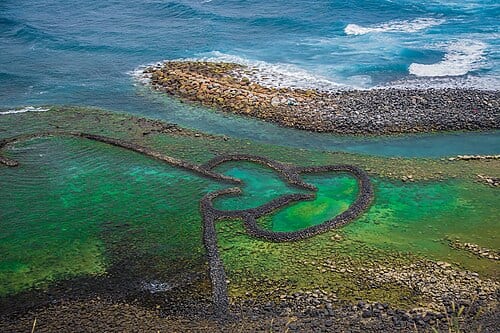
The Twin-Heart Stone Weir is a traditional fishing facility formed by two connected stone weirs, whose combined outline forms a double-heart shape when viewed from above; it was registered as a Penghu County cultural landscape in 2006, making it the most distinctive of the hundreds of stone weirs in the Penghu archipelago.
The Twin-Heart Stone Weir (Dingxi Weir) is built of stacked basalt with an inner and outer weir chamber. It was registered as a Penghu County cultural landscape by the Penghu County Government on October 27, 2006, making it one of the most iconic among Penghu's hundreds of stone weirs.
Highlights of Twin-Heart Stone Weir
Stone weirs are traditional facilities that Penghu fishermen have used for centuries to catch fish by harnessing the tides. The principle is to build arc-shaped stone walls along the reef coast: fish enter the weir with the incoming tide, and when the tide recedes they are trapped inside and cannot swim out, allowing fishermen to harvest the catch without large fishing gear. The exact date of construction of the Twin-Heart Stone Weir is difficult to determine, but the masonry technique and scale of the wall suggest it is a remnant from the Qing dynasty. The weir is still maintained regularly, and a weir-repair event is held each year — a continuation of the local traditional craft.
The best angle for viewing the Twin-Heart Stone Weir is from the viewing platform on the western side, which is at a suitable height to look down on the full heart-shaped outline. At low tide the exposed area of the stone walls is greatest and the lines are clearest. At low tide you can also walk along the reef-edge path and approach the outer wall of the weir, but stepping on the weir wall is prohibited to avoid damaging the stone structure built with traditional techniques. The reef coast around the weir also has tide pool ecosystems to observe; the basalt jointing is distinct, forming an interesting contrast with the man-made texture of the weir.
How to make the most of it
Practical information
Getting there & timing
- Qimei Township must be reached by ferry from Magong or other islands. For ferry schedules, check the Penghu County Government's Transportation and Tourism Bureau or the shipping company's official website; departures vary by season.
- Qimei Island is small; renting an electric bicycle or scooter to ride around the island is the most convenient option. The Twin-Heart Stone Weir is in the northern part of the island in Dingxi Village, about a 10-minute ride from Qimei Harbor.
Nearby connections
- Qimei Island's main attractions are clustered together. The Twin-Heart Stone Weir can be combined with Qimei Martyrs' Tomb, the Little Taiwan Landform, and the Dashi Longcheng Scenic Area into a single day of sightseeing; a full island loop takes about 2 to 3 hours.
- There are local snack shops near Qimei Harbor; consider planning lunch there as part of the island loop itinerary.
Sources: and Penghu County Cultural Affairs Bureau cultural landscape registration data.
Frequently Asked Questions
When was the Twin-Heart Stone Weir registered as a cultural landscape?
It was registered as a Penghu County cultural landscape on October 27, 2006.
How does the stone weir catch fish?
Fish enter with the incoming tide and become trapped when the tide recedes, allowing fishermen to harvest them by hand or with simple tools.
Can visitors walk on the weir walls?
No, the weir is a county-level cultural landscape with fragile basalt masonry, so climbing or stepping on the walls is prohibited.
Sources
- 七美雙心石滬-國家文化資產網 — 文化景觀登錄公告日期(2006年10月27日)
- 七美雙心石滬-國家文化記憶庫 — 石滬結構與登錄價值說明