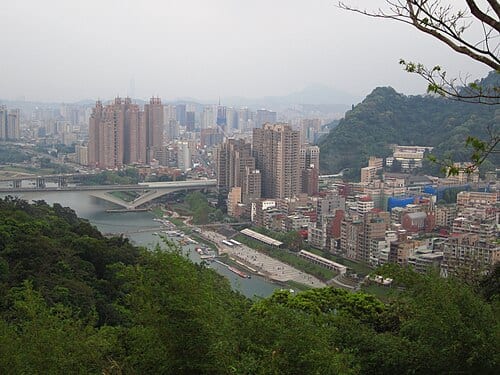
Bitan Scenic Area in Xindian is a scenic pool on the middle reaches of the Xindian River, formed where steep cliffs on both banks give the water its deep emerald color — historically a renowned recreation spot in northern Taiwan. The Bitan Suspension Bridge spanning both banks was built between 1936 and 1937, during the Japanese colonial era, designed by Taiwanese engineer Jiang Shiding and constructed by Chen Haisha's Guangzhi firm — the first bridge in Taiwan fully designed and built by Taiwanese people. The bridge is 186.6 meters long and was designated a New Taipei City monument in 2013.
Bitan Suspension Bridge began construction in June 1936 and was completed in 1937 (Showa 12); it is 186.6 meters long, 3.5 meters wide, and 20 meters high, designed by Taiwanese engineer Jiang Shiding and built by Chen Haisha's Guangzhi firm — the first bridge in Taiwan fully designed and constructed by Taiwanese people during the Japanese colonial era. It was designated a New Taipei City monument on August 5, 2013, and is now used only by pedestrians.
What to see at Bitan
Pedestrians can walk across the Bitan Suspension Bridge; standing at the center offers a view down onto the steep cliff terrain on both banks and the deep green water below, while boat activity on the surface can be watched from above. The east bank has a trail extending along the Bitan Scenic Area shoreline — the path is level, and fishermen and morning exercisers can be seen along the way. The west bank has a shopping street and dining area where weekend crowds concentrate.
Starting from Bitan, a cycling path extends north along the Xindian River and connects with the Jingmei River cycling path, forming a riding route toward the southwest of the Taipei Basin. Pedal boats are a distinctive recreational activity unique to Bitan; rentals are by the hour and suit pairs or families enjoying the calm water. Late spring through autumn (roughly April to October) offers favorable weather for outdoor activities; during winter northeast monsoon season, strong winds make water activities less suitable.
How to make the most of your visit
Practical information
Getting there and timing
- From Taipei MRT Xiaobitan Station (branch line), it is about a 10-minute walk to Bitan. You can also take the Xindian Line to Xindian Station and transfer by bus. Convenient transport is a key advantage.
- The outdoor area at Bitan is open all day. Pedal boat rentals are weather-dependent and may be suspended in rain or strong winds — check on-site notices.
Nearby connections
- Heading north from Bitan along the Xindian River cycling path, you can reach Yonghe or Banqiao riverside parks. The entire route is gentle and suitable for a half-day ride.
- Driving south about 40 minutes takes you to Wulai. Combine Bitan with Wulai hot springs: a morning visit to Bitan followed by a soak in Wulai.
Source: New Taipei City Government Tourism and Travel Bureau; Wikipedia entry on Bitan.
Frequently Asked Questions
When was Bitan Suspension Bridge built?
It was built between 1936 and 1937 (Showa 12) and is 186.6 meters long.
Who designed Bitan Suspension Bridge?
It was designed by Taiwanese engineer Jiang Shiding and built by Chen Haisha's Guangzhi firm, the first bridge in Taiwan fully designed and built by Taiwanese during the Japanese colonial era.
Can you still cross Bitan Suspension Bridge?
Yes, it is now used only by pedestrians and was designated a New Taipei City monument in 2013.
Sources
- 碧潭吊橋 - 維基百科 — 橋梁建造年份、設計者、結構型式(雙塔雙鉸單跨式)、古蹟公告日期
- 碧潭吊橋佇立將近90年!日治時期的歷史見證與情侶禁地傳說 - 報時光 — 歷史沿革報導,交叉核對建造年代與設計施工者