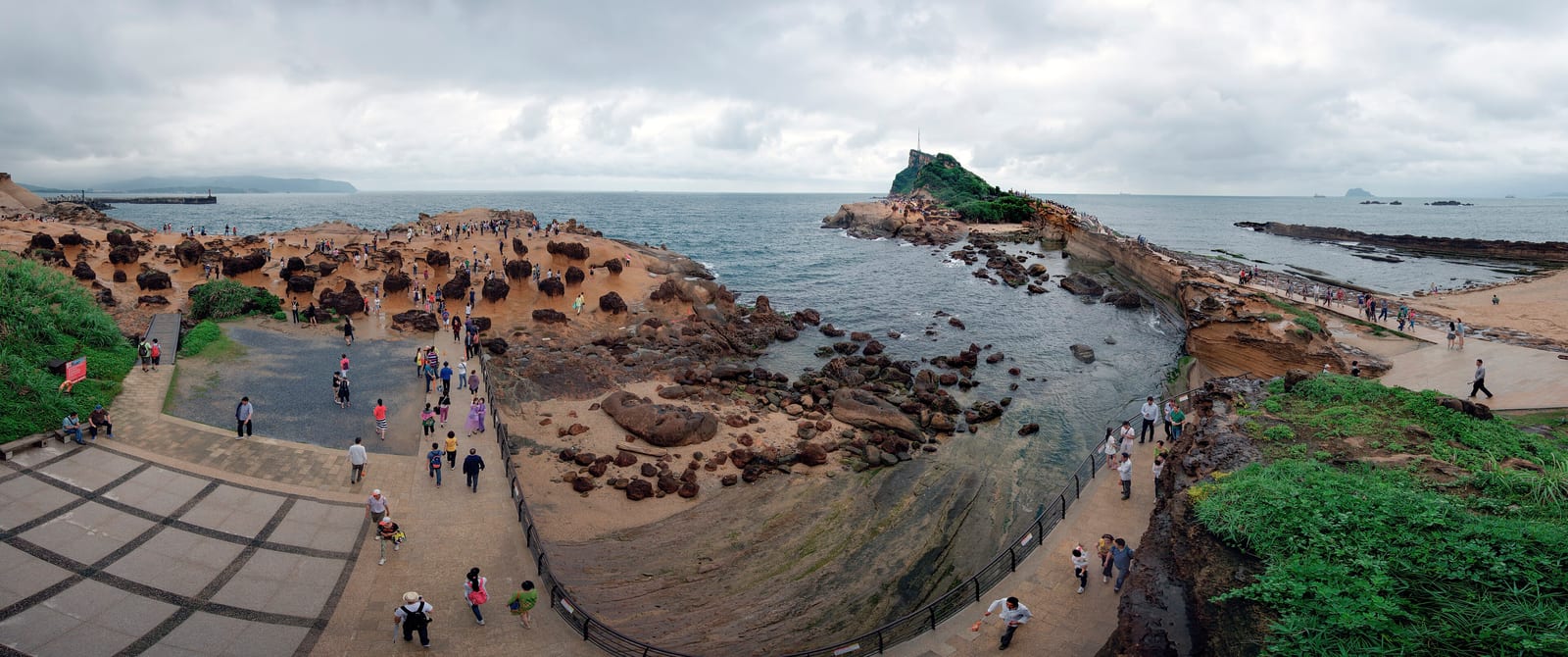
Yehliu Geopark is a geological park on a headland along the North Coast in Wanli District, New Taipei, stretching about 1.7 kilometers. Long-term erosion from waves, sea winds, and differences in rock hardness has carved mushroom rocks, candle rocks, and tofu rocks; among them, the Queen's Head, its profile resembling a silhouette, has become a globally recognized landmark drawing both geological researchers and general visitors.
The headland at Yehliu Geopark is about 1.7 kilometers long and 200 meters wide. The name "Queen's Head" originated from a 1962 photography exhibition, "The Forgotten Paradise," after the rock's profile was likened to a queen's side silhouette; the naming helped transform Yehliu from a fishing village into a major North Coast tourist destination. (Source: New Taipei Travel official site; local travel blog)
Highlights of Yehliu Geopark
The park is administered by the Tourism Administration's Northern Region Office, and the geological strata belong to the Miocene Taliao Formation of interbedded sandstone and shale. Wave erosion cutting along joints, combined with differences in rock hardness, has formed mushroom rocks with narrow bases and bulbous tops; candle rocks result from differential weathering of pyrite nodules, their surfaces showing ring-like patterns resembling candlesticks. The entire headland is divided into three touring zones, all connected by well-paved walkways.
The Queen's Head's neck has been growing thinner from years of weathering, and management periodically publishes neck-circumference measurements to track the erosion rate — a concrete case study in observing dynamic landform change. Beyond the rock formations, tidal pools host barnacles, crabs, and other creatures that can be observed up close, though touching the rocks anywhere in the rocky zone is prohibited to preserve the landforms.
How to make the most of your visit
Practical information
Getting there & timing
- Kuo-Kuang Motor Transport runs buses from Taipei MRT Tamsui Station and Keelung Train Station to Yehliu; check Kuo-Kuang's official timetable for schedules.
- By car, take the Jijin Interchange off National Freeway 1 onto Provincial Highway 2 heading north. The park has a paid parking lot that fills quickly on weekends — arriving early is recommended.
- Opening hours and admission fees are subject to the official announcements of the Tourism Administration's Northern Region Office; certain areas may be temporarily closed in severe weather.
Nearby connections
- Heading east along Provincial Highway 2 connects to Jinshan Old Street; heading west back toward Tamsui links to Tamsui Fisherman's Wharf — both fit naturally into a North Coast day-trip itinerary.
- Wanli District is also known for Wanli Crab (stone crabs), and during the autumn season (approximately September–November) you can enjoy freshly caught crabs at local restaurants.
Sources: Tourism Administration Northern Region Office, Yehliu Geopark official website, and Wikipedia entry for Yehliu Geopark.
Frequently Asked Questions
How long is the headland at Yehliu Geopark?
The headland is about 1.7 kilometers long and 200 meters wide.
Where does the name 'Queen's Head' come from?
It comes from a 1962 photo exhibition, after the rock's profile was likened to a queen's silhouette.
What are Yehliu Geopark's signature landforms?
Mushroom rocks, candle rocks, and tofu rocks, with the Queen's Head as its most famous landmark.
Sources
- 驚嘆奇景 野柳地質公園 - 新北市觀光旅遊網 — 海岬長度、女王頭命名
- 野柳地質公園,女王頭越來越細啦 - 豬爸一家 — 女王頭歷史