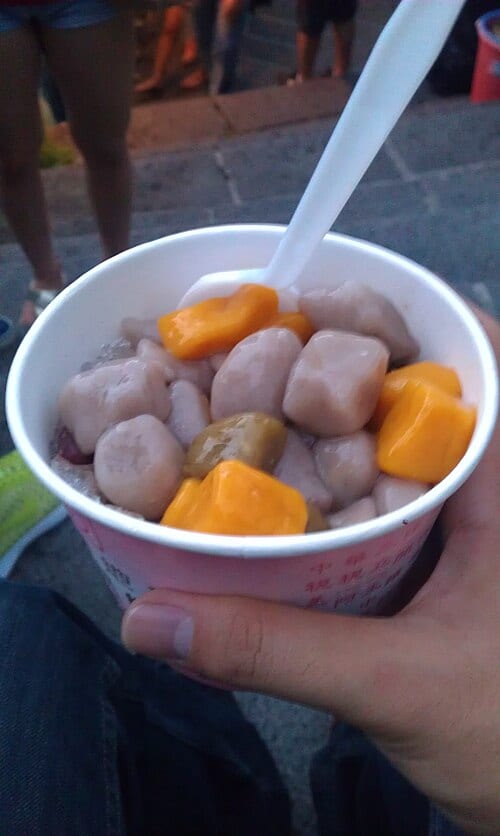
Taro balls are the signature dessert of Jiufen Old Street in New Taipei's Ruifang District, made by mashing steamed taro, kneading it with sweet potato starch, and hand-rolling the dough into small balls, served in hot soup or over shaved ice. Jiufen's first dedicated taro ball shop, Ah Gan Yi, opened in 1960 as a grocery stall beside Jiufen Elementary School; Lai A Po, which opened in 1991, was the first Jiufen taro ball shop to register a trademark, and both are known for their mountain-and-sea view seating along Shuchi Road and Jishan Street.
Ah Gan Yi Taro Balls opened in 1960 as Jiufen's first dedicated taro ball shop, evolving from a grocery stall near Jiufen Elementary School; Lai A Po Taro Balls opened in 1991 as the first Jiufen taro ball shop to register a trademark and is now run by its fourth generation. Taro balls as a dessert are said to have been developed in 1946 by Tsai Lin Bao-yun, a Ruifang resident.
What are taro balls?
Taro balls are a traditional dessert made by steaming taro, mashing it into a paste, mixing it with sweet potato starch to form a dough, and then hand-cutting and rolling it into small rounds. Sweet potato starch is key — it gives the balls a chewy bounce after cooking rather than turning mushy. Beyond plain taro balls, Jiufen shops also make sweet potato balls, matcha balls, and sesame balls in vivid colors that are pleasing just to look at. There are two ways to eat them: in winter, served in ginger or red bean soup for warmth; in summer, over shaved ice with brown sugar syrup, where the chewiness contrasts sharply with the cold.
The two emblematic shops of Jiufen's taro balls are Ah Gan Yi Taro Balls and Lai A Po Taro Balls, both open for over 60 years. Ah Gan Yi sits at the top of Shuchi Road near an elementary school and is famous for its three-story viewing seats — eating taro balls by the window with the panoramic mountain-and-sea view is one of Jiufen's most iconic images. Lai A Po, on Jishan Street, is known for hand-making everything fresh without takeout or delivery. Both are tourism landmarks with long queues on weekends. Jiufen's taro balls are not one shop's monopoly — they are the dessert symbol of the entire hillside town.
How to eat them like a local
Local knowledge
Verified credentials (sponsored content filtered out)
- Both Ah Gan Yi and Lai A Po Taro Balls have over 60 years of history and are the two signature taro ball shops in Jiufen.
- Jiufen taro balls use locally grown Taiwanese taro and sweet potato starch, with hand-rolling as the traditional method.
- Jiufen is located in the Ruifang District of New Taipei City in a hillside setting at about 350 meters elevation, with a climate that is often misty and rainy.
Visitor tips
- Parking in Jiufen is difficult. Drivers should park at lots lower on the mountain and walk or take a shuttle bus up.
- Shuchi Road is entirely stone steps, which makes it harder for people with mobility limitations — entering and exiting via Jishan Street is more level.
- Jiufen's weather changes quickly; even in summer the mist can roll in and temperatures can drop. A light jacket and rain gear are worth bringing.
Information compiled from the Michelin Guide, New Taipei City Tourism and Travel Bureau, and large volumes of public reviews, with sponsored content filtered out.
Frequently Asked Questions
When did Jiufen taro balls begin?
Ah Gan Yi, Jiufen's first dedicated taro ball shop, opened in 1960 as a grocery stall that also sold taro balls.
Which is older, Ah Gan Yi or Lai A Po?
Ah Gan Yi opened earlier, in 1960, while Lai A Po opened in 1991 as Jiufen's first trademark-registered taro ball shop.
How are taro balls eaten?
In winter they're served in ginger or red bean soup; in summer they're piled over shaved ice with brown sugar syrup, contrasting chewiness with cold.
What makes Jiufen taro balls distinctive?
Hand-rolling with sweet potato starch keeps the balls chewy, and eating them at view seating along Shuchi Road is Jiufen's classic experience.
Sources
- 九份第一家芋圓,1960年創立,無敵景觀芋圓老店 — 阿柑姨芋圓創立年份與歷史
- 賴阿婆芋圓|四代傳承的九份老店 — 賴阿婆芋圓創立1991年、商標註冊與傳承代數
- 芋圓 - 維基百科 — 芋圓起源與1946年發明者蔡林保雲