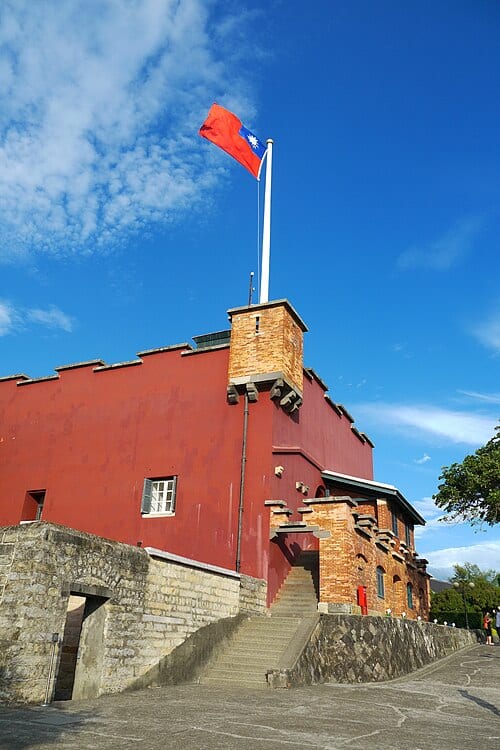
Fort San Domingo is a national historic site on high ground at the mouth of the Tamsui River. Its main fort was built in 1628 during Spanish colonial rule, later passing through Dutch, Zheng-era, and Qing dynasty control; from 1867 it served as the British consulate until Britain withdrew in 1972, and the site was formally returned to Republic of China ownership in 1980. Its meter-thick brick-and-stone fortress walls and the adjacent British Consulate together form one of Taiwan's most complete layered colonial heritage sites.
The main fort was built by the Spanish in 1628 as "Fort San Domingo"; the Dutch rebuilt it nearby in 1644 as "Fort Antonio." From 1867 (the 6th year of the Tongzhi era), Qing China leased it to Britain as a consulate; Britain withdrew in 1972, after which the site was managed in turn by Australia and the United States, before being formally handed over to the Republic of China government on June 30, 1980. It is now a national historic site. (Source: Chinese Wikipedia entry for Fort San Domingo; Central News Agency)
Highlights of Tamsui Fort San Domingo
The main fort's exterior walls are built of red brick; its solid arched window openings and cannon embrasures remain intact. The second floor retains remnants of a jail cell and gun platform, conveying the fort's original military defense function. The British Consulate, built in 1891, is in Victorian-era colonial architectural style; its interior has been restored to recreate scenes from the daily life of British diplomatic staff, forming a striking cultural contrast with the military main fort.
The site sits on high ground at the mouth of the Tamsui River. From the courtyard you can look out over the Tamsui River and the ridgeline of Guanyin Mountain on the opposite bank — particularly picturesque in the layered light of dusk. The interpretive displays present the political transitions from the perspectives of the Spanish, Dutch, and Qing administrations, making this a tangible space for understanding Taiwan's pre-modern history.
How to make the most of your visit
Practical information
Getting there & timing
- Take the Taipei MRT Danshui–Xinyi Line to Tamsui Station, then walk or take a Tamsui district bus along Zhongzheng Road; the walk takes about 25–30 minutes.
- Opening hours and admission fees are subject to the official announcements of the New Taipei City Government Department of Cultural Affairs or Fort San Domingo; the site may be closed on Mondays — confirm in advance.
Nearby connections
- Walking along Tamsui Old Street leads to Fisherman's Wharf, about 2 kilometers away. Bicycles are available for rent along the riverside path for those who prefer to ride.
- Zhenli Street in Tamsui concentrates multiple Japanese-era and Western-style buildings. A half-day historic walking route can be planned — starting in the morning is recommended to avoid crowds.
Sources: New Taipei City Government Department of Cultural Affairs, Wikipedia entry for Tamsui Fort San Domingo.
Frequently Asked Questions
Who first built Fort San Domingo?
The main fort was built by the Spanish in 1628.
When did Britain lease Fort San Domingo?
Britain leased it as a consulate from 1867 and withdrew in 1972.
When was it formally returned to Republic of China ownership?
It was formally handed over to the ROC government on June 30, 1980.
Sources
- 紅毛城 - 維基百科 — 歷史沿革
- 開箱老照片》英國交還淡水領事館紅毛城 - 中央社 — 1972年撤離、1980年交還