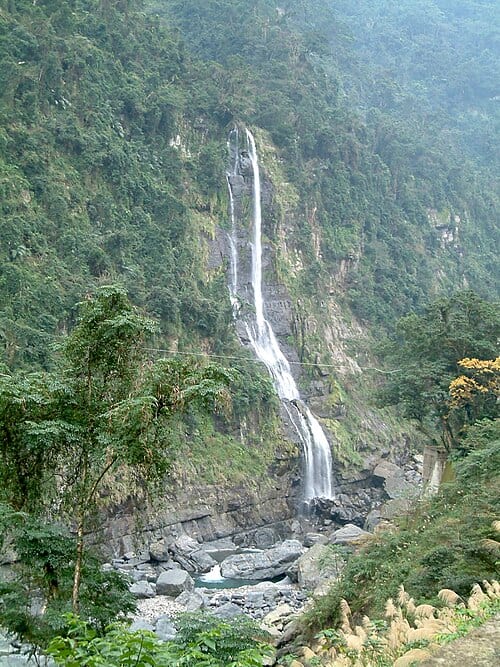
Wulai Waterfall is a waterfall on the upper Nanshi River in Wulai District, New Taipei City, with a drop of about 80 meters — one of the largest-drop waterfalls in New Taipei. The water plunges straight down the rock face with a roar audible from a distance. A scenic tram, converted from an earlier logging trolley line, runs to the Lansheng Bridge viewpoint, and combined with the Wulai hot spring district, forms a route that pairs the waterfall, the tram ride, and hot-spring bathing.
Wulai Waterfall has a drop of roughly 80 meters, among the largest in New Taipei City. The scenic Wulai tram running to the falls began in 1928 as a 545mm-gauge narrow line built by Mitsui Gomei Kaisha to haul timber; it was converted into a sightseeing tram in 1963 and switched to mechanized traction in 1974.
Highlights of Wulai Waterfall
The waterfall itself can be viewed head-on from Lansheng Bridge after taking the scenic tram (or walking) from Wulai Old Street; the tram ride is about 10 minutes each way and passes over the Nanshi River valley. The walking route follows the streamside trail upstream — a longer distance, but it lets you experience the stream environment up close. During the rainy season or after a typhoon, water volume doubles and the rock walls on both sides are nearly engulfed in mist during high water.
Wulai's hot springs are sodium bicarbonate springs (known as 'beauty springs') — colorless, odorless, and mild. Multiple public bathhouses and hot-spring hotels along the old street offer soaking services at a wide range of prices and facility levels; checking and comparing options in advance is recommended. Wulai District is the traditional homeland of the Atayal people; indigenous foods and crafts can be found for sale along the old street.
How to make the most of your visit
Practical information
Getting there & timing
- From Taipei MRT Xindian Station, take Bus 849 to Wulai Old Street; the journey is about 40–50 minutes. Check the New Taipei City bus real-time system for schedules.
- Scenic tram fares and departure times: check official Wulai scenic tram announcements. Service may be suspended after typhoons or heavy rain.
Nearby connections
- The Wulai Atayal Museum is located next to Wulai Old Street and is free to visit — it can be combined with the waterfall visit in the same day for cultural context.
- Xindian Bitan is about a 30-minute drive from Wulai. A Bitan–Wulai combination is possible; Bitan Suspension Bridge and Wulai Waterfall are very different in character.
Sources: New Taipei City Government Tourism and Travel Department, Wikipedia entry for Wulai Waterfall.
Frequently Asked Questions
How high is the drop at Wulai Waterfall?
Wulai Waterfall has a drop of about 80 meters, among the largest in New Taipei City.
What is the history of the Wulai scenic tram?
It began in 1928 as a 545mm-gauge line built by Mitsui Gomei Kaisha to haul timber, and was converted into a sightseeing tram in 1963.
What type of hot spring is Wulai's?
Wulai's hot springs are sodium bicarbonate springs, known as "beauty springs" — colorless, odorless, and mild.
Sources
- 烏來瀑布 - 維基百科 — 落差高度數據
- 烏來台車 - 台灣山林悠遊網(林務局) — 台車歷史、1928年興建、1963年轉觀光用途、1974年機械化