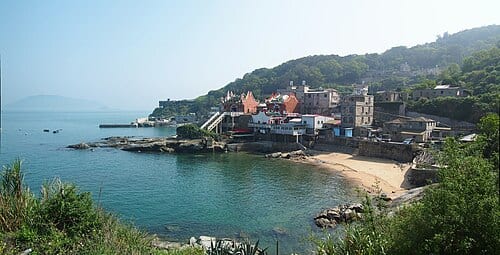
Qiaozi Village is a traditional fishing settlement at the northernmost tip of Beigan Island; official household registration counts about 494 people in 150 households (Lienchiang County, December 2025), though tourism sources and local accounts commonly describe only around seven households and fewer than a hundred people actually living there. The village has 8 temples enshrining close to 188 deity statues — the highest temple density in Matsu — earning it the nickname 'Temple Village,' where 'gods outnumber people.'
Qiaozi Village's official household registration (Lienchiang County, December 2025) lists 494 people in 150 households — but this is administrative registration, consistent with the well-known gap in Matsu between registered and actually resident population. Tourism materials and local reports commonly describe only around seven households and fewer than a hundred people actually living there, though this resident-population figure has no official statistical backing and is treated as unconfirmed. The village has 8 temples — the highest density in Matsu — enshrining deities including Baima Zunwang, Mazu, Xuantian Shangdi, and Lord Zhou of Shanxi Lingtai; the commonly cited total of about 188 statues appears in multiple reports but lacks an official census figure and is likewise unconfirmed.
Highlights of Qiaozi Village
During the Qing dynasty and early Republic of China period, Qiaozi was one of Beigan's most important fishing settlements, supporting a population of several hundred at its peak through fishing. As fish stocks declined and younger residents moved away, the village gradually emptied. Most surviving structures are granite stone houses built around World War II, with thick walls and Minyue-style swallow-tail ridge or hip-and-gable rooflines. Though some buildings have fallen into disrepair, their structural exteriors remain largely intact.
The settlement houses the "Qiaozi Fishing Village Historical Museum," which displays traditional fishing tools, everyday utensils, and records of past fishing practices — a good starting point for understanding Matsu's fishing culture. Eight temples are scattered throughout the village; modest in scale yet each with its own presiding deity, they reflect the diverse folk religious traditions brought by Minyue immigrants to Matsu. Wandering through the village, incense smoke and ruins coexist in a uniquely atmospheric stillness.
How to Make the Most of Your Visit
Practical Information
Getting There and Time Needed
- Beigan has an airport (about 15 minutes by air from Nangan) and ferry connections to Nangan and other islands. Once on Beigan, you can rent a scooter or take a taxi to Qiaozi Village.
- Qiaozi is at the northern end of Beigan, about 10 to 15 minutes by car from Beigan Airport, entirely on the island's internal roads.
- The settlement has no fixed opening hours. If the museum is closed, check with the Beigan Township Office for current access.
Nearby Connections
- Can be combined with Qinbi Village, Tanghou Beach, and Bishan for a Beigan day trip. Qiaozi is typically scheduled as a half-day stop in the morning or afternoon.
- From Qiaozi, following Beigan's north coast, you can see Daqiu Island in the distance. If time allows, consider a same-day boat trip to see the deer on Daqiu.
Source: Lienchiang County Government Bureau of Cultural Affairs, Matsu National Scenic Area Administration.
Frequently Asked Questions
What is Qiaozi Village's registered population?
Official household registration (December 2025) lists about 494 people in 150 households, though this is an administrative figure.
How many people actually live in Qiaozi Village?
Tourism materials and local reports commonly cite only around seven households and fewer than a hundred people actually resident, though this figure lacks official statistical backing.
Why is Qiaozi Village called 'Temple Village'?
It has 8 temples, the highest density in Matsu, commonly said to enshrine close to 188 deity statues — hence the nicknames 'Temple Village' and 'gods outnumber people.'
Sources
- 橋仔村 - 維基百科 — 戶籍人口/戶數統計(2025年12月)
- 【馬祖北竿--擺瞑文化祭系列之三】神比人還多的村落 — 8間廟宇/188尊神像等在地說法