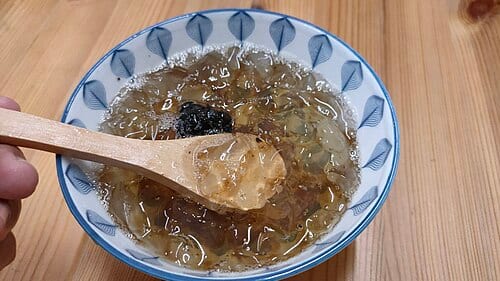
Seaweed jelly (shi hua dong) is a natural plant jelly made in Matsu by boiling shi hua cai (Gelidium amansii, a red alga) until it sets, harvested from the reef coastlines of islands such as Beigan, mainly from spring through early summer (roughly March–May by the lunar calendar).
Shi hua cai (Gelidium amansii) is a red alga that requires clear, fast-flowing seawater and rocky reef habitats to grow. Taiwan seaweed resource data indicate its peak harvest period runs roughly from the third to fifth lunar month; after sun-drying, boiling, and straining, the liquid is cooled until it sets into a semi-transparent jelly. The species is found along northern and northeastern Taiwan's rocky coasts as well as offshore islands including Matsu.
What Is Seaweed Jelly
Shi hua cai (scientific name Gelidium amansii) is a red alga that grows on intertidal rocks. The Matsu archipelago has abundant rocky coastline, with Beigan's Banli shore as the main harvesting area. After collection, the seaweed is sun-dried repeatedly until fully dry, then slow-boiled for several hours, strained of impurities, poured into containers, and left to cool and set into a semi-transparent jelly. The texture is refreshing and silky, with a subtle, delicate oceanic flavor. It is served with brown sugar water or condensed milk, with sweetness adjustable to personal taste. The harvest season runs from late spring through summer (April–August).
Seaweed jelly has a culinary tradition throughout the Min-Dong coastal region (Fuzhou, Lianjiang, and Changle), and immigrants who crossed the sea continued this food custom on the Matsu islands. Compared to the factory-produced agar-based jelly (derived from Irish moss) widely sold on Taiwan proper, Matsu's shi hua dong is hand-boiled from wild-harvested seaweed, with a more complex flavor profile and a distinctive mineral quality from the rocky reef waters. The Lianjiang County Tourism Bureau lists shi hua dong as Beigan's signature summer food, and the Matsu Daily has published multiple articles documenting the Banli seaweed harvesting culture.
How to Eat It the Local Way
Local Knowledge
Verified References
- The Lianjiang County Tourism Bureau website records shi hua dong as a traditional Beigan summer dessert, and the Beigan Township Office's agriculture and fisheries documentation identifies Banli shore as the primary shi hua cai harvesting area.
- Multiple Matsu Daily articles document the Banli seaweed harvesting culture, confirming this is a food tradition carried over by Min-Dong immigrants — not a recent tourist invention.
Visitor Notes
- Shi hua dong is seasonal. Visiting Beigan before April or after September usually means no fresh handmade version is available; some souvenir shops carry vacuum-sealed dried versions.
- When buying, confirm the product is made from wild-harvested shi hua cai, not agar powder. Authentic handmade shi hua dong sets softer and carries a faint seaweed scent.
Sources: Lianjiang County Tourism Bureau website; Matsu Daily shi hua cai harvesting culture coverage; Beigan Township Office agriculture and fisheries documentation.
Frequently Asked Questions
What is seaweed jelly made from?
It is made by boiling and straining shi hua cai (Gelidium amansii red algae), then letting it cool and set — no additives are used.
When is shi hua cai in season?
Its peak harvest period runs roughly from the third to fifth lunar month, spanning spring to early summer.
How is seaweed jelly typically eaten?
The traditional way is drizzled with brown sugar ginger water; condensed milk or plain versions are also common.
Is seaweed jelly the same as the agar jelly common on Taiwan proper?
No — seaweed jelly is hand-boiled from wild-harvested shi hua cai, while agar jelly is typically factory-made from processed Irish moss extract.
Sources
- 石花菜 - 食農教育資訊整合平臺 — 石花菜物種特徵、生長環境與產季
- 小旅樸食:石花凍 — 石花凍製作工序(曬乾、熬煮、放涼凝結)