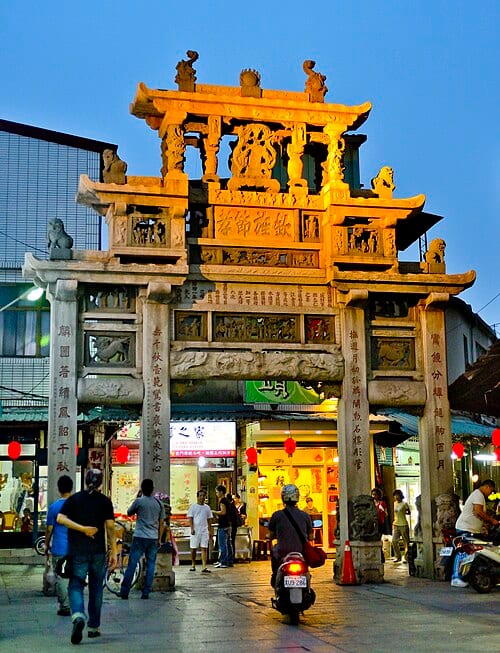
Qiu Lianggong Mother's Memorial Arch is a granite paifang erected in 1812, the 17th year of the Qing Jiaqing reign, to honor the chastity and filial devotion of Xu, mother of naval commander Qiu Lianggong. It is Kinmen's only national monument and is considered the largest and best-preserved memorial arch surviving in Taiwan.
Qiu Lianggong Mother's Memorial Arch was built in 1812, the 17th year of the Qing Jiaqing reign. It is Kinmen's only national monument and is regarded as Taiwan's largest and best-preserved surviving memorial arch, known as the "finest paifang of the Min-Tai region" (source: National Cultural Heritage Database, Bureau of Cultural Heritage, Ministry of Culture). Qiu Lianggong (1769–1817) served as deputy commander of the Taiwan Naval Brigade and Dinghai Garrison commander in Zhejiang before rising to Naval Commander-in-Chief of Zhejiang — not "Naval Commander-in-Chief of Fujian" as sometimes reported (source: Chinese Wikipedia, "Qiu Lianggong").
Highlights of the memorial arch
Qiu Lianggong (1769–1817) was a native of Jincheng, Kinmen, and a Qing dynasty naval commander who served as Military Commander of Taiwan and Naval Commander-in-Chief of Fujian, renowned for suppressing the pirate Cai Qian. His mother Xu observed widowhood and raised her children alone after Qiu Lianggong's father died young; the Qing court recognized her as a model of chastity and filial piety and ordered a commemorative arch built in her honor. The arch was constructed by Minnan stone-carving craftsmen and took more than a year to complete, finished at the height of Qiu Lianggong's prestige as admiral.
The arch follows the four-column, three-bay form. The central bay rises to a tall gatework, with lower door lintels on either side. The front face bears the characters for Imperial Edict, clearly identifying the arch as an imperially commissioned monument. Columns, arch tablets, and all horizontal beams are covered in relief carvings whose subjects include dragons and phoenixes, flowers, processions of civil and military officials, and auspicious motifs, all executed with deep and layered carving. The local granite used for the stone has weathered for two hundred years, yet the carving lines remain sharp and complete.
How to make the most of your visit
Practical information
Getting there and timing
- The arch is on Zhongxing Road in Jincheng Township, close to the town center. It is accessible on foot or by scooter, with public parking nearby.
- The arch stands in a public outdoor space and can be viewed at any time. As a national monument, climbing on it or touching the stone carvings is prohibited — please keep a respectful distance.
Nearby connections
- Adjacent to Jincheng Township's old commercial street (Mofan Street). After viewing the arch you can walk to the old street to try traditional Kinmen snacks such as Cantonese congee and oyster omelette.
- The Wujiang Academy, Kinmen County Cultural Park (former Kinmen Normal School), and other cultural-history sites in Jincheng Township can be included on the same day for a full-day humanities route through the township.
Sources: Cultural Heritage Bureau, Ministry of Culture, national monument records; Kinmen County Cultural Affairs Bureau interpretive information.
Frequently Asked Questions
When was Qiu Lianggong Mother's Memorial Arch built?
It was built in 1812, the 17th year of the Qing Jiaqing reign, to honor the chastity and filial devotion of Qiu Lianggong's mother, Xu.
Was Qiu Lianggong the naval commander-in-chief of Fujian?
No — he served as deputy commander of the Taiwan Naval Brigade and Dinghai Garrison commander before becoming Naval Commander-in-Chief of Zhejiang, not Fujian.