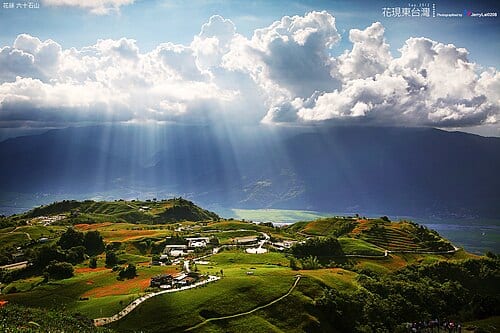
Liushidan Mountain is a highland plateau in Zhutian Village, Fuli Township, Hualien County, at an elevation of roughly 700 to 900 meters, and is one of Taiwan's major daylily (Hemerocallis fulva) growing areas. Two explanations exist for the name: one holds that rice paddies here once yielded 60 shi (石) of grain per unit of land during the Japanese era; another attributes it to about 60 large boulders scattered across the slope. The daylily season runs from July to September, peaking in August and September.
Liushidan Mountain rises to roughly 700 to 900 meters, with its highest point around 965 meters. The name has two origin stories: one attributing it to rice paddies yielding 60 shi of grain per unit of land during the Japanese era, the other to about 60 large boulders scattered on the slope. The daylily season runs July to September, peaking in August and September.
Highlights of Liushidan Mountain
The Liushidan plateau is flat and open with long hours of sunlight and well-draining soil, ideal for large-scale daylily (Hemerocallis fulva) cultivation. Daylilies are grown primarily as a food crop (the fresh yellow flowers are the ingredient), and eastern Taiwan has the island's largest growing area, with Liushidan Mountain as the most concentrated production site. During the flower season, the plateau's orange-yellow blossoms are saturated in color under morning light or evening glow, drawing large numbers of photography enthusiasts.
Multiple observation decks on the plateau offer panoramic views of the flower fields, with the Hualien-Taitung Rift Valley and the Coastal Range visible in the distance. Outside the flower season, the plateau's gently rolling terrain and quiet atmosphere are still worth experiencing, but the sea of flowers is concentrated in August to October — plan accordingly. The plateau road is a winding mountain lane requiring slow driving, and queues may form on weekends.
How to Make the Most of Your Visit
Practical Information
Getting There & Time
- From Fuli Township town center, follow signs to Zhutian Village and Liushidan Mountain. The mountain road takes about 15 to 20 minutes; on weekends, set out early to avoid traffic.
- The daylily season is August to October; late August to mid-September sees the most abundant blooms. Visiting outside the flower season offers little scenic reward.
- Mountain temperatures vary noticeably between morning, afternoon, and evening. Daytime during the summer flower season can be hot — bring sunscreen and adequate water.
Nearby Connections
- Fuli Township can be paired with Luoshan Waterfall and Luoshan Natural Ecological Village for a half-day to full-day Fuli itinerary.
- Yuli Town is approximately 20 minutes north, connecting the mid- and southern rift valley attractions.
Sources: Fuli Township Office, East Coast National Scenic Area Administration tourism information.
Frequently Asked Questions
How high is Liushidan Mountain?
It rises to roughly 700 to 900 meters, with its peak around 965 meters.
Where does the name Liushidan come from?
There are two theories — 60 shi of rice yield per unit of land in the Japanese era, or roughly 60 large boulders on the slope.
When is daylily season at Liushidan?
The season runs July to September, peaking in August and September.
Sources
- 六十石山 - 維基百科 — 記載海拔700-900公尺(最高965公尺)、地名兩種由來說法、花季7-9月尖峰8-9月