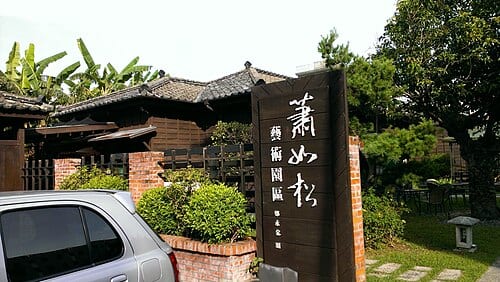
Hsiao Ju-sung Art Park is a Japanese dormitory arts cluster in Zhudong Township, Hsinchu County, centered on the former residence of watercolor painter Hsiao Ju-sung (1922–1992). Born in Mengjia, Taipei, Hsiao taught at schools in the Zhudong area from 1945 until his retirement in 1988, never leaving the town for nearly half a century. After his death, his residence fell into disrepair until it was restored in 2004 and combined with five surrounding Japanese colonial-era teacher dormitories to form today's art park.
Hsiao Ju-sung (1922–1992) was born in Mengjia, Taipei, and taught at schools in the Zhudong area from 1945 until his retirement in 1988, remaining in the town for nearly half a century. After his death in 1992, his residence sat vacant and deteriorating until it was restored in 2004, when it was combined with five surrounding Japanese colonial-era teacher dormitories — a site of roughly 2,000 square meters — to form today's art park.
What to see at Hsiao Ju-sung Art Park
Hsiao Ju-sung (1923–1992) taught for many years in Zhudong, depicting the mountain townscapes of Hsinchu and everyday still lifes in a delicate, luminous watercolor style. His work holds a distinctive place in the history of Taiwanese watercolor painting. The park begins at his former home and expands to incorporate the surrounding Japanese colonial-era teacher dormitories, forming a small art cluster. The tile roofs, verandas, and courtyards of the Japanese wooden buildings preserve the architectural vocabulary of the Showa period — precious documents of everyday life history in their own right.
Beyond the permanent collection of Hsiao Ju-sung's original watercolors, the park exhibits works by local artists, and some spaces rotate themed special exhibitions. Zhudong is the most populous township in Hsinchu County; the park serves as an important public arts space in the district. Weekend craft markets and art events are held occasionally, giving the place a lived-in, neighborhood feel.
Tips for getting the most out of your visit
Practical information
Getting there and timing
- Get off at Zhudong Station on the TRA Neiwan Line and walk about 10–15 minutes. Train service is infrequent — check the timetable before departing.
- Opening hours and closing days are set by the Hsinchu County Cultural Affairs Bureau's official announcements; hours may change on certain public holidays.
Nearby connections
- From Zhudong you can extend to Beipu Old Street (about 15 minutes by car) or Emei Lake (about 20 minutes by car) for a half-day Hakka mountain trip.
- Neiwan Old Street is accessible by the Neiwan Line train — a good add-on for visitors who enjoy short heritage railway journeys.
Sources: The Wikipedia entry for Hsiao Ju-sung Art Park and Hsinchu County Government Cultural Affairs Bureau records.
Frequently Asked Questions
What kind of place is Hsiao Ju-sung Art Park?
It is a Japanese dormitory arts cluster in Zhudong Township, Hsinchu County, centered on watercolor painter Hsiao Ju-sung's former residence, comprising five Japanese colonial-era teacher dormitories that display his and local artists' work.
Who was Hsiao Ju-sung?
Hsiao Ju-sung (1922–1992) was born in Mengjia, Taipei, and taught in the Zhudong area from 1945 until retiring in 1988, remaining there for nearly half a century — a significant figure in the history of Taiwanese watercolor painting.
When did the park take shape?
After Hsiao died in 1992, his residence fell into disrepair; it was restored through the efforts of multiple parties in 2004 and combined with the surrounding Japanese dormitories to form today's park.
What can visitors see inside the park?
The park displays Hsiao's original watercolors and personal artifacts, along with works by local Zhudong artists in rotating themed exhibitions; the Japanese wooden buildings themselves are a valuable historical asset.
Sources
- 蕭如松 - 維基百科 — 生卒年、出生地、任教學校年表
- 藏身竹東鬧街巷弄中的蕭如松藝術園區 - 台灣品設計 — 故居修復年份、園區規模